Showing posts with label indigenous rights. Show all posts

Monday, February 9, 2015

While peace is negotiated, human rights violations in Cauca, Colombia continue

While peace talks between the Colombian government and the FARC guerillas continue, many of Witness for Peace's partners on the ground emphasize that a lasting peace with social justice requires more than just an end to hostilities between the state and the insurgency. The following statement from human rights defenders in the southwestern province of Cauca regarding the recent increase in attacks on human rights defenders illustrates why the U.S. must urge the Colombian government to protect human rights defenders in their important work and include civil society voices in peace building efforts.

By the Cauca Network for Life and Human Right (CIMA, CRIC, MCC, Acader, Ascap, Ruta Pacifica de Mujeres, Ordeurca and Cococauca)

We highlight the important advances that the peace talks in Havana have made regarding the FARC’s unilateral ceasefire, the discussions of a possible bilateral ceasefire and the reduction of hostile actions in civilian areas. However, the Cauca Network for Life and Human Rights denounce to the international community that the end of 2014 and beginning of 2015 has seen an increase in human rights violations in the province of Cauca. These include assassinations, assassination attempts and threats against human rights defenders and community leaders, along with an increase in femicides and extrajudicial killings.

The statistics gathered by our network’s Observatory on Human Rights and International Humanitarian Law indicate that in December 2014 and January 2015 in Cauca at least 10 indigenous, campesino and Afro-Colombian organizations have been threatened via pamphlets, phone calls and text messages signed by “Los Rastrojos,” “Aguilas Negras” and other unidentified groups. Leaders are being threatened for opposing illegal and multinational mining operations in their territories. Among the organizations and leaders most affected are the members of the Untied Afro-Cauca Organizations (UAFROC) and the Afro-descendant Women’s Movement for Life and Territory from Suarez, who have also been victims of attempts on their life and forced displacement. Similarly, leaders from the National Afro-Colombian Advisory Council were threatened by pamphlets distributed in the Guapi, Cauca City Hall.

The member organizations of the Cauca Network for Life and Human Rights are on high alert in the wake of assassinations of human rights defenders. In two months, two community leaders and one public official were killed: on December 9, 2014 on the highway from Popayan to Purace, Elkin Dario Mompotes, a leader of the Indigenous Mining Company, was killed by hired assassins; on January 15, 2015, Emiro Medina Velasco, the Manager of the Municipal Legal Office in Caloto, was killed; and on February 4, men dressed in civilian clothing and driving a motorcycle assassinated Heriberto Narvaéz, a campesino leader from El Patía. To these we can also add the murder of Congreso de los Pueblos member and leader Carlos Pedraza, which occurred in the rural outskirts of Bogotá. Together they demonstrate the lack of protections for the work of human rights defenders and their participation in the construction of peace in this country.

Women are another group that has been strongly impacted during this period. The Observatory on Human Rights and International Humanitarian Law has registered at least eight femicides, which represents a 50 per cent increase from the previous reporting period. Along with this there have been repeated threats and intimidations against Afro-descendant women from northern Cauca, who have been publicly demonstrating since last year in defense of their territory against illegal mining. This includes the forced displacement of leader Francia Marquez and her family.

This year also began with community reports of excessive force and abuse of authority by members of the 29th Brigade of the Colombian Military in the village of El Plateado, near the city of Argelia, Cauca. On January 18, Faiber Cuellar, 28 years of age, was assassinated by soldiers who indiscriminately opened fire after requesting him to stop at a checkpoint.

The beginning of this year has also seen an increase in common violence. As of the current date, in the cities of Santander de Quilichao, Popayán, Puerto Tejada and El Tambo at least 48 people between 18 and 30 years of age have been murdered.

The Cauca Network for Life and Human Rights urges the Colombian government to comply with its responsibility to protect lives and human rights, investigate and punish those responsible for these crimes and to create the conditions necessary to effectively protect human rights defenders and organizations. Peace will not be possible if there are no protections for the defense of human rights and no mechanisms for the participation of civilians, social organizations and social leaders in peace building.

Popayán, Cauca, Colombia

Friday, April 11, 2014

What does 'clean energy' mean for indigenous communities in Mexico's Isthmus of Tehuantepec?

By Miriam Taylor, Witness for Peace Mexico Team

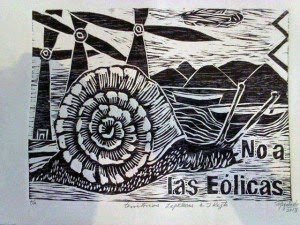
"No to wind farms"
Image credit: Climate Connections

Driving through southern Mexico’s Isthmus of Tehuantepec, the countryside unfolds like a glimpse into the not-so-distant future. Wind turbines turn busily as far as the eye can see, no fossil fuels required. As one of the windiest places in the world, this seems like an ideal way to reduce greenhouse gas emissions and a promising step toward combating climate change. But in the global clamor for access to the burgeoning renewable energy market, winners and losers have already emerged. The local communities of the Isthmus region, largely indigenous, have at best been bribed, coerced, and misled into conceding their land rights to wind farm companies. At worst they have been ignored outright, and the federal and state government have granted land permits without free, prior and informed consent, and communities are fighting back.

Currently, the construction of the projected twenty-eight wind farms in the Isthmus region is half-finished. The construction companies are mostly Spanish: Iberdrola, Acciona, Endesa, Gamesa, and Gas Natural Fenosa, with international investments by corporations ranging from General Electric to Energy France and Mitsubishi. It is estimated that in terms of wind energy, the region has a production capacity of between 5,000 and 10,000 megawatts, which is enough to provide 18 million people with electricity. This energy, however, will not be available for consumption by the people who live in the Isthmus. It is destined for businesses such as FEMSA (a Coca-Cola subsidiary), Wal-Mart, Heineken, CEMEX, and Bimbo.

After the Mexican Revolution in 1917, the land rights of peasants were enshrined in the Constitution under Article 27 through the ejido system of communal land ownership. Although the federal government later instituted programs that would enable communities to privatize their land, the majority have opted not to do so, thus making land permits granted without previous consultation illegal.

In addition to Article 27, the rights of indigenous peoples are further protected by the Constitution through an amendment to Article 2, which states, “This Constitution recognizes and protects the right to self-determination of indigenous people and communities and, consequently, their right to autonomy, so that they may… (V) maintain and improve their habitat and preserve the integrity of their lands…” These protections, however, have proved ineffectual in practice. Pedro López Orozco, member of the Alvaro Obregon’s Peoples Assembly, commented in a recent interview with The Americas Program, “We as indigenous people have seen a high level of corruption in the three levels of government. For the State, the law is dead.”

In addition to communities being left in the dark about projects, additional environmental impact studies are needed to determine what the effects of the wind farms would be on the local population, ecosystems, and water resources. The Isthmus is a migratory bird corridor, and records show a marked increase in bird deaths caused by wind turbines. The turbines also require lubricants and other substances that have made their way into both the sea and fresh water aquifers. Fishermen have noted that fish have begun to leave areas close to the turbines, presumably due to their vibrations. And although research shows that wind farms have little effect on human health in sparsely populated areas, the Isthmus is home to 3.8 million residents, many of whom live within the area affected by the noise pollution generated by the turbines, which has been found to be 4,500 feet upwind and 7,000 feet downwind.

Then comes the issue of payment. The vast majority of the inhabitants of the Isthmus live off subsistence farming and fishing. Renting their land for the construction of wind turbines has the potential to be positive for these communities and could provide sorely needed income in a country where an estimated 75% of indigenous people  live in poverty. Corporations, however, have paid paltry rent sums that are only a fraction of what they would have had to pay in countries such as the U.S. or Denmark. Landholders report payments of 138 Mexican pesos (or US $12) per hectare per year, which is substantially less than they would make selling cow’s milk produced on that same land, for example.


Members of the Popular Assembly of the People of Juchitán provide security for events organizing resistance to wind farms. 

Communities of the Isthmus have resisted continued marginalization since the beginning of this process. In the municipality of Juchitán in 2006, a group of neighbors decided to start a community radio project, Radio Totopo, using very basic equipment that would inform citizens about developments in the wind farm project in their native Zapotec language. In March of last year, Radio Totopo was attacked by state police and hired hitmen and much of its equipment was destroyed. Many of those who run the radio have received death threats or have been physically assaulted by groups they say were hired by the wind farm companies in order to intimidate them.

As a result of the community collaboration in the radio project, the Popular Assembly of the People of Juchitán was formed. For several months members of the assembly took turns manning a physical barricade fashioned out of scrap metal, wood, and tarp that prevented access to the construction zone for a wind farm project planned by Mareña Renewables, a consortium of Dutch, Australian, and Japanese investment interests. The barricade withstood attacks by local, state, and federal police, the army, hired hitmen and paramilitary groups.


Residents physically blocked the entrance to the construction zone for a Mareña Renovables wind farm. The sign reads, "No to wind farm projects in the communal lands of Juchitán!"

On January 1st of this year, another local municipality, Álvaro Obregón, took things one step further. In the spirit of the 1994 Zapatista uprising in Chiapas, the community’s general assembly invoked the United Nations ILO Convention 169 and the 1996 San Andrés Accords, declaring itself an autonomous municipality. Inhabitants renounced all relationships with the state and federal government and affiliation with all political parties. However, the current mayor of Álvaro Obregón, Saúl Vicente Vázquez, does not recognize the validity of the move and has taken steps to de-legitimize it.

The situation in the Isthmus has many layers, but is quite straightforward. The Mexican government has promoted the growth of alternative energy sources in the country using mechanisms like the North American Free Trade Agreement (NAFTA) and pro-corporate development projects such as the Mesoamerica Project. Doors were opened to international investors, banks, and multinational corporations, which benefit from the wind farms in myriad ways. Corporations from developed countries can take advantage of the Clean Development Mechanism of the Kyoto Protocol, which enables them to invest in clean energy projects in the developing world and use the carbon credits from the project toward emissions reductions targets. They also collect the profits generated by the project itself. Businesses that consume the electricity can also receive Renewable Energy Certificates (RECs) that they can count toward emissions reductions targets or sell as carbon offsets to other entities.

But the land belongs to the people who have lived, fished, and farmed there for centuries. If they were included in the process with open access to information, were given a fair share of the profits produced by the wind farms, and if corporations could ensure the protection of the environment, the Isthmus has the potential to be a model of the future of renewable energy. Instead it’s become yet another example of neoliberalism disguised as sustainable development, and the people of the Isthmus are committed to stopping it.


"Wind farms yes, but not like this"
Image credit: Asociación Arcera


Wednesday, October 23, 2013

7th Milpa Festival: Indigenous Communities Resist


Three months before the 20th anniversary of NAFTA, I found myself in an old school bus traveling through the Sierra Juarez in Oaxaca, Mexico. The landscape was unbelievably beautiful. Riding on the curvy roads I saw dense green vegetation and endless chains of mountains.

The Sierra Juarez´ flora and fauna have been preserved because they have powerful allies: indigenous people who have fought for centuries to protect their land, their culture, their way of life, and mother earth. A cloud of butterflies, indicators of the vast biodiversity of the land, greeted me upon my arrival to Santa Gertrudis.

I traveled to Santa Gertrudis to attend the 7th Milpa Festival, an event organized by the Union of Organizations of the Sierra Juarez of Oaxaca (UNOSJO). During the event, participants from Guatemala, Honduras, Brazil, and Mexico discussed ways to protect their territory and their native seeds.

It was inspiring to watch community organizers and small-scale farmers talk about their experiences of resistance and share their analysis and skills. Despite the efforts of the Mexican government and transnational companies to completely transform rural Mexico into something that they can better exploit and profit from, these communities persevere.

The transformation of rural Mexico

The majority of Mexico’s farmers belong to marginalized indigenous groups. They grow food for their families on small plots of land using ancestral knowledge and sustainable technologies. For many, agriculture is still a sacred and communal activity.


Since NAFTA, government agricultural programs have supported multinational corporations and large agribusinesses instead of small-scale farmers, whose inability to compete have resulted in increased poverty, and mass migration to the United States.

The Mexican government is working together with U.S. companies (Monsanto, Dow, Pioneer, DuPont, etc.) to transform Mexico’s agriculture into an export-oriented mono-crop system that is dependent on agrochemicals and GMO/hybrid seeds.

The neoliberal ideal is for people to produce food for sale (not for personal use) and that they buy products sold in the global market (made by transnational corporations). This is achieved by creating conditions that make it more expensive to grow food than to buy it, or by imposing government programs that make small-scale farmers dependent on products made by transnational corporations. These strategies end the traditional practices that have allowed indigenous communities to remain self-sufficient and sustainable for centuries.

Indigenous small-scale farmers who want to defend their native seeds and traditional food systems find themselves fighting against these types of government programs as well as a barrage of misinformation from national media campaigns.The most iconic struggle in Mexico thus far, has been the fight to defend native corn.

In defense of corn

Corn was domesticated in Mexico thousands of years ago and the country holds a huge percentage of the world’s diversity; in the state of Oaxaca alone there are 35 species of corn. In 1998 the Mexican government declared a moratorium on the cultivation of GMO corn. But this type of corn was already being distributed by a federal food safety program that made cheap GMO corn from the United States available to low-income families.

In 2001 Ignacio Chapela, a scientist from Berkeley University, found GMO corn in the Sierra Juarez in Oaxaca.The corn was probably planted unwittingly by a farmer that obtained food through the government’s food safety program.

In 2005, the Bio-Security Law of Genetically Modified Organisms opened the doors to GMOs in Mexico. The law, designed to regulate the cultivation of GMO crops in Mexico, is so beneficial to GMO corporations that it became widely known as the Monsanto Law.

In 2009, for the first time in Mexican history, the government granted permissions to cultivate GMO corn in several northern states. Mexico’s current president, Enrique Peña Nieto, recently approved the cultivation of an additional 250,000 hectares.

Small-scale farmers and civil society have been fighting these initiatives all along. Some of their concerns are: the potential health effects of GMOs in humans, the contamination of non-GMO crops, the contamination of the areas of origin of corn, the loss of genetic diversity that could result if cheap GMO corn becomes the standard, the dependency of rural communities on expensive GMO seeds and agrochemicals, the loss of traditional systems of production, and the effects of GMOs and agrochemicals on the environment.Without this resistance, GMOs would probably be the norm in rural Mexico.

Resistance takes place daily when farmers or whole communities refuse to use non-native seeds or agrochemicals. Sometimes this means that they must abstain from participating in government programs.

PROCAMPO, for example, is a government aid program created to support small-scale corn farmers by distributing vouchers for seeds and other agricultural products. Many low-income farmers depend on these types of programs for production. Unfortunately the vouchers can only be used on U.S. hybrid corn and technology packages that include agrochemicals (most of which are produced in the United States).

"Are you hungry? Drink Pepsi.
Another example is the Crusade Against Hunger, one of the main programs of the Peña Nieto administration. The program is known for partnering with multinational corporations to distribute unhealthy processed foods in low-income communities throughout the country to “combat hunger”, instead of promoting healthy foods. Part of the initiative is “Oaxaca’s Program for Self-Sustaining Agriculture”, which aims to provide assistance to small-scale farmers in Oaxaca who produce only enough crops to feed themselves and their families. The model is the same as PROCAMPO’s: farmers receive aid in the form of hybrid seeds and agrochemicals.

For those dependent on government programs there is no option to use native corn or to produce crops in a traditional way. The programs make it more expensive to produce native organic corn, and ensure that farmers will become consumers,dependent on foreign seeds and foreign technology.

Click here to read a statement from Oaxaca’s Coalition in Defense of Native Corn about “Oaxaca’s Program for Self-Sustaining Agriculture”.

Despite the lack of governmental support and the pressure to participate in these programs, indigenous small-scale farmers continue to resist.

In July, farmers, organizations, and activists filed a class action suit against federal authorities and companies who are complicit in the legalization and planting of GMOs in Mexico. On October 10th a federal judge ruled in their favor, suspending all current and future efforts to plant GMOs in Mexico until the resolution of several pending lawsuits. This has offered a glimmer of hope that eventually GMOs will be permanently banned from Mexican soil. The struggle must continue.

At the Milpa Festival I heard many people speak about a possible solutions to these issues: government support of the use of native seeds and ancestral cultivation techniques, valuing and supporting indigenous people’s knowledge, improvement of food production in a way that respects the environment and indigenous peoples’ way of life.

As I remember the faces and the voices of the farmers I met in Santa Gertrudis, I think of all the people in the United States who are fighting a similar battle against GMOs, mono-cultivation, and agrochemicals. But people in the United States have the additional responsibility of holding their government and U.S. corporations accountable for their role in the implementation of so many of the neoliberal policies that are affecting the rural global south. As we work together, trans-nationally, I feel confident that we will win this fight.


Get Involved!
More information:

Wednesday, August 21, 2013

My experience on a Roots and Realities of Migration delegation to Oaxaca

by Jessica del Villar

I was recently given the opportunity to go on a Roots and Realities of Migration delegation to Oaxaca, Mexico with two organizations called Witness for Peace and Student Action with Farmworkers. The focus of this trip was, as the name implies, to learn about the causes of migration and the harsh realities of the issue. Although this trip started out as more of an educational experience, for many of us delegates, it was much more than that.

Being a Mexican-American student at Duke has obviously had its rough spots. Jumping from a community that was so inundated with Hispanics, where it was a necessity to speak Spanish, to a community like Duke, where as a Hispanic you are part of the clear minority, was more of a culture shock than I could have ever imagined. Finishing up my first year I was definitely left questioning my identity and the role I played outside of my community bubble. Along with wanting to be more educated about the impacts of immigration reform, I wanted to find a way to connect with a culture that I felt was so overshadowed (if that’s the right word) at Duke and I hoped that going to Mexico would help me do that.


Logistically speaking, my ten day visit to Oaxaca included trips to different towns, a homestay visit and various speakers. We got to eat authentic Mexican food, spend our afternoons roaming the city, and soak up as much of the culture as we possibly could. A few days into our trip we visited a town up in the mountains called Capulalpam de Méndez. Capulalpam is known for its amazing self-dependence and continuous fight against mining companies. It uses its beautiful scenery to lure tourists and educate them about  the highly unwanted mega project presence in their small town while providing an interesting experience and benefiting from needed economic gain.

We also visited CEDICAM, an organization based in Nochixtlán, a town on the other end of the spectrum, that  was struggling from a lack of water, bad climate, and difficulty getting their youth to contribute to the needed farm labor. They utilized a method of farming called milpa, which involves growing beans, squash and corn together. From what I understood, planting these seeds together allows for more efficient farming. The three crops assist each other in the growing process, which also describes an ideal community of people helping each other grow.


Up next was our homestay visit in Teotitlán del Valle. We spoke to the women of Vida Nueva, a women’s weaving cooperative that honored  fair prices for their labor. During our visit, we were able to fully immerse ourselves in our family’s daily life. We cooked with our host families, took the children to school and visited the local market early in the morning.

Personally, these two days were the highlight of the trip. This small town with its simple homes and few paved roads made me think of what my grandmother’s childhood must have been like. It was not only an extremely educational experience but an emotional one as well. From using the same laundry soap (Zote), to the invariable presence of Coca Cola, it was like my grandma was right there with me. Being able to experience this environment was well... I can’t really describe what this was like, it just felt right. Like I finally understood something that I hadn’t understood for so long. I understood why my grandmother and her children (including my mother) had made the treacherous journey to the U.S. I understood why all the women in my family were such hard workers, and why they focused so much on getting ahead and improving their family’s futures. I understood where my grandma’s little habits and sayings came from and everything just felt right. This was what I had come for. This feeling of just being right.


Leaving Teotitlán was probably the hardest part of this trip. I don’t know why. Going in, I knew that my host family had to go on with their life and I had to go on with mine. I just didn’t expect to get so attached and gain such a high level of respect for a family in the span of two days.


Upon leaving Teotitlán, we visited COMI, a migrant homeless shelter that provides food and shelter to migrants traveling north. Here, we spoke to a member of the organization and to 8-10 migrants coming from different Latin American countries. The most touching of these people were the two children making the journey. An 11 year old boy and 8 year old girl were on Day 15 of their journey from El Salvador to America. I’ve grown up around first generation migrants all my life but I’d never encountered children so young who had made the journey. The other migrant’s stories were, of course, horrible and difficult to hear but watching these children sit there during our discussion without fully understanding the difficulties they would face was heartbreaking.

What future lay ahead for them? First off, their future could take two separate roads. They would either make it to the border or...well, not. If they did successfully cross into the United States, they would face a huge culture shock and a rough transition into school on top of the certain racism and discrimination that would somehow come their way. As  older kids, they wouldn’t be able to get driver’s licenses, apply for financial aid or just generally have the other opportunities other kids have. Why should they be affected by a future they didn’t choose? Why should they  bear the consequences? They’re just kids.

I don’t know.

I’m sure that I’ve left out a lot of things from my time in Oaxaca and I know that once I submit this I’ll regret not including so-and-so, but overall this was my experience. People have asked me what my time in Oaxaca was like but it’s not exactly easy to put so much into a few sentences. I’m sure that this whole piece has been choppy and not the greatest thing ever but I hope that it has at least provided some insight into what I learned and I hope it inspires others to learn more about the causes and effects of migration.

My time in Oaxaca gave me some of the most memorable and educational experiences of my life (so far) and I am eternally grateful to all the people that made this trip possible.


On a last note:

I hope that my host family is doing well and that they continue to be as happy as they were then I met them.


I hope that the two Salvadoran children have made it to the United States safely. I hope they can still experience some of the joys all children should be able to experience. I hope the little girl thinks of me on May 12, our shared birthday, as I’ll certainly be thinking of her. And I hope that they prosper and don’t grow up to be bitter about their standing as immigrants in the United States. I hope they don’t blame their mother.


I hope close-minded Americans can stop being so ignorant and actually educate themselves about the migrant experience.

And I hope that this has sparked some thought into every reader’s personal migration story and realization that, whether ten years ago or a hundred, we all came from somewhere and that somewhere is not here.

Witness for Peace Group Focuses on Food Sovereignty and Immigration Issues

by Joan Fumetti

It has been said that privilege is invisible to those who have it. Our trip to Oaxaca provided a unique opportunity for us to see our lives, our information base, and our government policies through the eyes of indigenous people whose daily lives are impacted by our own.

Our goal was to listen, reflect and learn what it might mean to live in solidarity with people who are immersed in traditions and cultures that, though challenged and often disrespected, have remained a vibrant source of shared strength and vision.


It was apt that a group of Iowans venture to the place where corn was domesticated. “The most impressive aspect of the maize story is what it tells us about the capabilities of agriculturalists 9,000 years ago,” (New York Times: Remarkable Creatures: Tracking the Ancestry of Corn Back 9,000 Years). Listening to the descendants of these ‘pioneer geneticists’ we began to see corn with a bit of the reverence they accord it; corn is life in Oaxaca, not just commodity. We heard of their concern for the purity and biodiversity of the native seed they seek to protect from contamination by the transgenic (GMO) corn that is grown here. Whatever our take on the U.S. food system, it became clear that the voices we heard need to be part of an ongoing conversation. ‘One size fits all’ is not good agricultural policy in a world with so many different cultural, geographic and climatic contexts. We need to broaden the conversation so that U.S. corporate and government interests become increasingly sensitive to these human realities.

Our study of the roots of immigration revealed the devastating effects of NAFTA on the Mexican agricultural sector and Oaxacan farmers in particular. The large majority of Oaxacan farmers grow corn for local consumption and demand has always been high for their produce. When cheap U.S. corn flooded the Mexican market following NAFTA, local farmers were no longer able to compete for a share of the market. Communities fragmented as men in particular felt their only option for sustainable income was migration. Many of them come to the United States where they work in our agricultural sector as tirelessly as they’d worked at home.

The soul-warming hospitality offered to us when we stayed in the homes of women who are part of a weaving cooperative was poignant, for men were conspicuously absent. They are a strong and resilient bunch of women with whom we fell in love. We now feel compelled to tell the story that migration breaks the hearts of communities. People, by and large, want to stay home with their families and make a living through work that accords dignity. As we share their stories with our friends and communities, we hope the connections we’ve observed and experienced will help others understand the importance of dealing with immigration in ways that make compassionate sense. 

Thursday, August 23, 2012

Nimbyism and Colombia’s “Socially Responsible” Mine, Cerrejón


By Jeanine Legato
WfP Colombia

Southeastern Massachusetts, where I am from, was deeply embroiled in a nimby (Not-In- My- Backyard)  debate in 2008 about the proposed construction of Cape Wind, an offshore wind farm in Nantucket sound.  The debate lasted years and only recently passed its final regulatory obstacle of approval by the Federal Aviation Association.  In the meantime, it has dominated local airwaves, newspapers, and public discussion, and called the attention of just about every important national news outlet. The innocuous “How ‘bout them Red Sox” conversation in Massachusetts shifted for a long time to, “How ‘bout that wind farm?” Critics of the farm, bent on saving the view sheds of their waterfront homes have lost out over time to the proposal’s proponents, who fought for the environmental, economic and energy security benefits of renewable energy.

Yesterday, in the Wayuu Indigenous Reservation of Provincial located in the northern Colombia province of La Guajira, I witnessed another nimby scenario play out, albeit colored by much different circumstances, none so privileged as a debate over the Kennedy’s vacation home, and certainly not as well covered by the media.

Culminating a five day expedition along the banks of the Rancheria River to document its degradation since the arrival of coal-giant Cerrejón (BHP Biliton, Xstrata, Anglo American), and to call for the defense of the same ecosystem before the mine’s proposed 26 kilometer detouring of the river to mine the high quality coal beneath, communities called a press conference in Provincial and asked, “why is our resistance ignored in the media?”

The answer: Cerrejón, whose slogan is “Mining Responsibly”, dominates the press-beat in La Guajira with its multi-million investment in communications.  Furthermore, while the Cape Wind project was stalled by years’ long debate and strict environmental regulations, Cerrejón has been subjected to neither by the Colombian press or government.  President Juan Manuel Santos promotes deregulated mining and foreign investment to make extractive resources the “economic engine” for the country.

To the 150 participants on a five day excursion for the defense of the Rancheria River, comprised of Guajiran community members, and national and international NGO representatives, the economic myth was manifest.  La Guajira is Colombia’s poorest province, 34 years after Cerrejón’s arrival.  In visiting three of the dozens of communities displaced by Cerrejón, the mine’s claim to social responsibility was questionable at best.

In Patilla, multiple families remain in the dust-polluted town in the shadow of a massive mountain made of mining waste.  Cerrejón claims that Patilla is its most successful relocation case, boasting a video on its website of an inaugural party at “New” Patilla, the urban resettlement where Patilla residents were relocated.  Not featured in the video are the dozens of families that Cerrejón did not relocate on grounds that they were Patilla natives, but not residents.   As a result of the job precariousness that the mine imposed on the once agricultural economy, many Patilla natives moved part-time into town to find work or facilitate easier commutes to their kids’ schools.  Cerrejón refuses to compensate them for their homes or include them in rights to relocation.  To pressure the “resisters” to sell, Cerrejón has cut off their electricity for weeks at a time and been late in sending potable water supply to the community (the Rancheria River, once suitable for human consumption, cannot be used even for cattle due to mining pollutant content).

Further down the road, eight families remain in Roche, once the area’s densely populated social capital.  In its rush to relocate residents to New Roche, Cerrejón fueled disputes in the community, offering financial rewards for the families who were willing to leave Roche the quickest and delegitimizing the community leaders who advocated for resistance or slower-paced negotiations.  In April 2012, Cerrejón filed for the Colombian State to expropriate the remaining Roche families, a process that may occur in early October without Cerrejón having made a good-faith effort to work through tenuous points in the negotiation.

Three Inhabitants of Roche are unable to span the circumference of a Caracoli tree found along the Rancheria’s river banks.  Cerrejon’s expansion threatens the over two-hundred- year presence of local Afro Colombian communities as well as ancient flora and fauna.
As a Wayuu Indigenous community, Provincial strongly opposes the rerouting of the Rancheria River. They have begun an internal reflection process to preclude the prior consultation process that Cerrejón, required by ILO 169 and Colombian law, would have to carry out before exploring the project.  Cerrejón president Roberto Junguito told local press that an expansion project indicating the detouring of the Rancheria hasn’t been officially presented, making the communities’ call for debate and consultation on the topic an unnecessary controversy.    

Children in the Provincial Reservation perform a traditional Wayuu dance representing an edible cactus flower found in their territory.

However, according to independent news outlet La Silla Vacia, the Ministry of the Interior- the entity responsible for oversight of prior consultation- confirmed that Cerrejón solicited the formal initiation of the prior consultation process on November 29, 2010 and December 7, 2010. Prior consultation is not to be confused with prior consent; Cerrejón has been widely criticized by communities and NGOs alike for misrepresenting information regarding damages in the consultation process and, as with the case of the Rancheria River, not consulting with communities before advancing legal exploration processes with the Colombian government.  

The collective experience of just these few communities is enough to give legitimate claim to their campaign’s simple slogan, “Cerrejón lies.”

 Bathing in the Rancheria, running my hands along the riverbed and turning up baseball-size pieces of coal, I had to agree.  Walking through the woods and finding half- hidden pipes that spew black coal processing water into the river, I had to agree.  Cerrejon’s ridiculous claim that rerouting the river would not cause further harm to communities is a shameless lie, or, at best, a deranged dismissal of the dizzying damage this mine has already caused to suffering communities over the course of three decades.

150 delegates representing local, national, and international communities traversed the Rancheria River over five days to document the environmental characteristics of Guajira’s most important water source.

This is a case of nimbyism where there is no possible benefit to the locals.  100% of Cerrejón coal is exported, including to the U.S market.  What Guajirans stand to lose from the rerouting of the Rancheria River is not just a view, but the last vital life source sustaining them in the face of forced displacement.      

Join the Witness for Peace Colombia team in their current investigative project to find out where Cerrejón coal is being imported to in the U.S.  Write colombia@witnessforpeace.org to get involved.

Friday, July 6, 2012

Gold Rush in Colombia: Part 1

by Amanda Tello

Colombia is one of the most bio-diverse, resource-abundant countries in the world. Home to the Amazon rainforest, the Andes mountains, la Guajira desert and the Pacific and Caribbean coasts, it contains more than “10% of the world’s plant and animal species.” Beneath the rich soil lie the keys to Colombia’s energy development as well as the sources of continual violence and displacement: oil, coal, emeralds, silver, nickel, copper and – gold. Before the arrival of the Spanish conquistadors, gold mining was an important means of survival for the indigenous population and continues to support millions of small-scale miners throughout the country. The recent surge in prices and demand for gold have sparked a modern-day “gold rush,” which has ignited a conflict between local communities and an influx of foreign corporations looking to profit from Colombia’s vast natural resources. The state’s desire to capitalize on the mining boom and present Colombia as an investment-friendly country has especially threatened Afro-Colombian and indigenous communities who inhabit strategically important territory and practice small-scale mining in many areas.

Mining Boom 

In recent years, the Colombian government has been campaigning to increase production in the extractive energy sector as a “development” strategy that will bring employment, infrastructure and wealth to the country. Beginning under the Uribe administration, the government implemented the “National Plan for Mining Development and Environmental Policy Vision Colombia 2019,” which seeks to “convert Colombia into a ‘mining country’” by establishing mining districts targeted for development. Current President Juan Manuel Santos has enhanced the government’s support for extractive industries, declaring mining an “activity for public utility and social interest” that will bring “prosperity to all.” Consequently, the number of mining licenses granted to individuals and multinational corporations (MNCs) has increased significantly in recent years. According to a report published by Peace Brigades International (PBI), “Mining in Colombia: At What Cost,” “between 1990 and 2001 in Colombia, 1,889 mining licenses were awarded (157 per year), but by 2010 there were already 8,928 concessions (4,839,149 hectares) and 20,000 applications pending.” In other words, 40% of Colombian territory has either been awarded or solicited by multinational corporations in the mining and energy sectors.

Minister of Environment; Right: Minister of Energy and Mining. El Tiempo
The modern “gold rush” in Colombia has been further fueled by the increase in market price and worldwide demand for the precious commodity, with a substantial portion of that demand emanating from the United States. The price of an ounce of gold increased from US $700 in 2008 to US $1,800 today, providing a strong incentive for corporations to invest in Colombia. Moreover, Vision Plan Colombia 2019 hopes to increase gold production from 40 tons annually to 80 tons in the next year. The combination of these factors has led to record foreign direct investment (FDI) in Colombia. During an interview at the World Economic Forum, Colombian Energy and Mining Minister Mauricio Cardenas said he “expects a $10 billion investment in crude oil, energy and mining projects in 2012.” In 2011 alone, “82% of the FDI in Colombia went to the energy sector” and overall investment grew by 113% to $14.4 billion.

Legislative Reforms 

With the hope that mining would become an economic “engine of growth,” the government enacted legislative reforms to benefit the mining industry. Law 685, referred to as the Mining Code, was passed in 2001 under the advisement of a law firm representing “half of the mining companies found in the national mining registry,” including a number of Canadian companies that now comprise 43.41% of the mining corporations in Colombia. Under this law, mining companies no longer need licenses for all phases of mining activity so they can begin the exploration phase without obtaining authorization. Subsequently, companies do not run the risk of losing their licenses due to potential environmental degradation or protestation from local communities.

Open Pit Mining Outside Segovia – PBI

Following a recommendation from the World Bank, Colombia “eliminated the State’s role in direct investment,” which not only limited its power to oversight and regulation but also “ended the possibility of State earnings from net returns.” Therefore, the state only benefits from the “surface rights fees and royalties that companies pay during exploration and mining phases.” Corporations also benefit from low royalty levels and tax exemptions, which are lower now than they were in the 1990s. Currently set at 4%, the royalty rates for gold extraction are so low that some experts argue Colombia is effectively paying “multinationals to extract their resources,” especially given the enormous environmental and social costs that large-scale mining operations often inflict.

The Plight of Afro-Colombians and Indigenous Peoples

Listening to President Santos’ rhetoric on the potential of the mining industry to create employment, foster security and alleviate poverty, it appears to be a win-win situation for citizens and corporations. However, a more complicated picture emerges when the plight of Afro-Colombian and indigenous communities are considered. Colombia is home to more than 102 indigenous groups totaling almost 1.4 million people and between 4-13 million persons of African descent. The competition over mining operations oftentimes threatens the resource abundant territories and livelihoods of Afro-Colombian and indigenous peoples, many of who have been mining in their communities for decades or centuries.

Although the Constitution formally recognizes the rights of Afro-Colombian and indigenous communities in the form of “collective land titles” and reserves, they face constant threats from armed actors and the “implementation of economic development or mega-projects,” such as mining. The government has further exacerbated the precarious plight of these groups by awarding mining licenses in indigenous reserves and collective territories belonging to Afro-Colombians without first obtaining the “prior and informed consent” of local communities – a right guaranteed in the Colombian Constitution as well as the UN Declaration on the Rights of Indigenous Peoples. For example, in July 2010, the UN Permanent Forum on Indigenous Issues determined that “mining concessions had been awarded in 80% of legally recognized reserves.” Not to mention, 27% of indigenous peoples and 60% of Afro-Colombians live outside of legally recognized territory and thousands of pending requests are being delayed in order to ensure the development of mega-projects.

Afro-descendent Community Lands – Indigenous Reserves -- PBI
Many inhabitants of these territories have been practicing small-scale, artisanal gold mining for generations. It is estimated that five million people subsist on small-scale mining in 44% of Colombia’s municipalities. However, many of these mines are not legally registered with Ingeominas, the government agency responsible for mining operations. According to reports from InSight, 6,000 small-scale mines are not legally registered, which comprises as many as 50% of Colombia’s mines. The 2001 mining code mandated that small-scale miners register their operations within a three-year period. Subsequently, the government was overwhelmed with requests and the “the legalization process quickly fell into a limbo.” Out of 2,845 requests submitted during the stipulated time period, only 23 were approved. Additionally, many miners in remote regions were not aware of the new requirements, lacked the resources to apply or found that their lands had already been ceded to MNCs.
PBI
Although small-scale mines produce the majority of Colombia’s gold, they face growing competition from primarily Canadian, English and South African mining corporations. As a result, small-scale miners “find themselves increasingly marginalized and in some cases persecuted for their traditional labor,” which is viewed as an obstacle to modern, industrial mining and investment. In fact, mncs have been found guilty of partnering with paramilitaries and other armed actors in order to intimidate labor union and community leaders and displace local populations from resource rich lands.

According to PBI and the National Mining Company Minercol Workers Union:

“80% of the human rights violations that have occurred in Colombia in the last ten years were committed in mining and energy-producing regions, and 87% of Colombia’s displaced population originate from these places.”
“At least 20 trade unionists from the mining and energy sector suffered attacks or attempted assassinations in 2010 and 78% of the crimes against trade unionists were committed in mining and energy areas”
According to professor and author Mario Murillo, the state’s support of large-scale mining projects and failure to obtain the “prior and informed consent” of impacted communities has paved the way for the disappearance and displacement of indigenous and Afro-Colombian peoples. Consequently, these marginalized groups make up a disproportionate number of the 3-4 million people displaced in the conflict thus far. It is estimated that indigenous peoples represent up to 7% of the displaced population and Afro-Colombians up to 17%. As PBI’s report astutely surmises, the decades-long conflict in Colombia is essentially a “competition over the use of the soil and subsoil for implementing economic projects,” in which Afro-Colombian and indigenous peoples are tragically viewed as obstacles to progress.

Special thanks to Peace Brigades International for their research on this topic.

Wednesday, May 23, 2012

The DEA killed the Hopes of Hasked Brooks Wood

Ahúas, Gracias a Dios
Wednesday, May 23, 2012
By: defensoresenlinea.com
Translation by the Witness for Peace Nicaragua Team
For the original version in Spanish please visit Defensores en Linea
A team of human rights defenders of the Committee of Family Members of the Detained and Disappeared (COFADEH) reports the deep pain of family members of the 14 year old boy, Hasked Brooks Wood, victim killed in the reckless attack lead by forces of the Drug Enforcement Agency (DEA) in which two pregnant women and the best friend of Hasked, Wilmer Walter (14) and Emerson Martiínez also died.
Defensoresenliena.com interviewed Hasked Antonie Brooks Symore, Hasked’s father who, upon learning of the fateful news traveled from the island of Roatán to find that he had been missing for 48 hours. 
Brooks Symore expressed himself with distress and anguish, “I feel terrible because I didn’t know that something like this would happen in this life, but we’re always here hoping that human rights organizations will come and help us (referring to COFADEH).”
“Upon seeing you all I feel a little better because I know that you will help us to pressure the government.  I feel accompanied by COFADEH,” explained the father of the adolescent who lost his life in the brutal attack.
Brooks Symore commented that his pain was even stronger because he knew the other people who had died and because various members of their families live in his home community and because of his wife, Clara Wood Rivas, who survived by throwing herself from the pipante (boat) into to the great waters of the Patuca River.
Choking on her words, Clara Wood Rivas said that upon hearing the bursts of gunfire she jumped into the river to get to the coast.  She heard the buzzing of the projectiles that passed closely by her body.
Swimming as rapidly as she could, when she got to the coast she screamed as loud as she could, “Hasked!…Hasked!...” but her son did not respond.  She woke up on Saturday and had no news of her son until many hours later.  The young boy had disappeared.
Upon hearing the news that Hasked was dead, the only thing she cried out was, “They have killed my baby…they have killed my baby!”
It is known that  when the attack began, a helicopter was seen  descending rapidly in the dark early morning in the community of Paptalaya and that it pointed itself directly at the pipante in which at least 15 people were being transported.  Hasked heard the detonations and one of those shots penetrated his mouth, another his head and a third projectile hit his abdomen and a fourth struck one of his legs.
That day the young Hasked was very happy because he was coming back to live in the community El Naranjal in Ahúas, where he was born.  This place is inhabited by a few wood houses built on stilts; Families plant basic grains, vegetables, raise cows and each family has one horse.
Hasked brought with him his fifth grade report card, a ball, a pair of cleats and his pet named Dragon (his little dog).  Dragon has not wanted to eat anything while staying Brooks Wood’s house, his family commented.
His happiness was greater because during the trip from the Barra Patuca to Paptalaya where the small boat was headed, he was seated next to his best friend Wilmer Walter, 14 years old who  received a grave injury to one of his hands.  The human rights defenders at COFADEH visited him in the Regional Hospital in Atlántida and confirmed that the condition of his hand has a reserved prognosis and that it needs the attention of specialists.
Accompanying Hasked, Clara and Wilmer was Vera Gonzáles, a relative of Brooks Wood and her daughters Chantel who recently turned two and 11 year old Alana; all three  survived the attack unharmed.
Brooks Symore has made his life in shrimp boats that fish the Roatán and also as a cook.  Part of the year he works in Islas de la Bahía and the rest he spends with his family which is composed of nine members.
He commented that the events of Friday the 11th of May of 2012 in Ahúas leave an impression that “one doesn’t know what will happen in life and without expecting it, one is attacked like that.  I didn’t think that that would happen because things like that never happen in these parts.”
Brooks Symore appreciated the visit and company of COFADEH whose human rights defenders came to visit this far-off community that has been forgotten and that currently faces serious threats from narco-trafficking.

Wednesday, April 18, 2012

Voices from the People's Summit

By WFP Colombia Team

As Presidents from across the Americas were getting set to gather for the Summit of the Americas April 14-15, social movements from across the hemisphere gathered in Cartagena at the People's Summit.

In the video below, co-produced by Witness for Peace and Fellowship of Reconciliation, human rights defenders, labor leaders and indigenous people discuss their vision of U.S. policy. Check it out.

Monday, October 18, 2010

Colombian Minorities Develop Policy Proposals for the New Santos Administration

By Andrea Bachmann

Last weekend more than 17,000 people gathered at Bogota’s National University for the inaugural meeting of the Congreso de los Pueblos - the “Peoples’ Congress.” Known as the Minga in previous years, the event was originally established in 2008 to unite indigenous groups from different regions in a shared struggle for their cultural and traditional rights.

This year, organizers decided to expand, renaming the event to reflect a more diverse attendance. Indigenous groups joined Afro-Colombians and other ethnic groups, labor unions, students, and various social organizations from across the country to express their solidarity, discuss the mutual challenges they face, and develop proposals for the new Santos administration.

On Friday October 8th, participants arrived by the busload and marched to the university, transforming it from campus to small community. Cooking fires roared, drums and flutes sounded, soccer matches ensued, and even a few small stores emerged along rows of tents and buses.

Indigenous guards lead the Peoples' Congress in the event's final march through Bogota on Oct. 12

Over the following three days, Congress attendees took part in round table discussions organized by problematic topic, by occupational sector, and by region of origin. All were given the opportunity to offer input on issues such as land and labor rights, institutional violence, education, economic development, and human rights. The conclusions reached at these meetings were then compiled into a proclamation, "Word of the Peoples' Congress: The Country's Proposal for a Life of Dignity."

On its fifth and final day, the Peoples' Congress culminated in a march from the National University to the Plaza Bolivar, a central plaza in downtown Bogota, where organizers formally presented the proclamation and musicians led the crowd in a final celebration of unity. The movement - now three years in the making - showed unprecedented growth that is only expected to continue in years to come.

Andrea Bachmann is a Witness for Peace intern based in Colombia.