Showing posts with label protest. Show all posts

Friday, April 11, 2014

What does 'clean energy' mean for indigenous communities in Mexico's Isthmus of Tehuantepec?

By Miriam Taylor, Witness for Peace Mexico Team
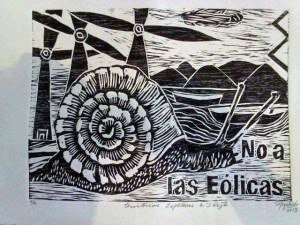
"No to wind farms"
Image credit: Climate Connections

Driving through southern Mexico’s Isthmus of Tehuantepec, the countryside unfolds like a glimpse into the not-so-distant future. Wind turbines turn busily as far as the eye can see, no fossil fuels required. As one of the windiest places in the world, this seems like an ideal way to reduce greenhouse gas emissions and a promising step toward combating climate change. But in the global clamor for access to the burgeoning renewable energy market, winners and losers have already emerged. The local communities of the Isthmus region, largely indigenous, have at best been bribed, coerced, and misled into conceding their land rights to wind farm companies. At worst they have been ignored outright, and the federal and state government have granted land permits without free, prior and informed consent, and communities are fighting back.

Currently, the construction of the projected twenty-eight wind farms in the Isthmus region is half-finished. The construction companies are mostly Spanish: Iberdrola, Acciona, Endesa, Gamesa, and Gas Natural Fenosa, with international investments by corporations ranging from General Electric to Energy France and Mitsubishi. It is estimated that in terms of wind energy, the region has a production capacity of between 5,000 and 10,000 megawatts, which is enough to provide 18 million people with electricity. This energy, however, will not be available for consumption by the people who live in the Isthmus. It is destined for businesses such as FEMSA (a Coca-Cola subsidiary), Wal-Mart, Heineken, CEMEX, and Bimbo.

After the Mexican Revolution in 1917, the land rights of peasants were enshrined in the Constitution under Article 27 through the ejido system of communal land ownership. Although the federal government later instituted programs that would enable communities to privatize their land, the majority have opted not to do so, thus making land permits granted without previous consultation illegal.

In addition to Article 27, the rights of indigenous peoples are further protected by the Constitution through an amendment to Article 2, which states, “This Constitution recognizes and protects the right to self-determination of indigenous people and communities and, consequently, their right to autonomy, so that they may… (V) maintain and improve their habitat and preserve the integrity of their lands…” These protections, however, have proved ineffectual in practice. Pedro López Orozco, member of the Alvaro Obregon’s Peoples Assembly, commented in a recent interview with The Americas Program, “We as indigenous people have seen a high level of corruption in the three levels of government. For the State, the law is dead.”

In addition to communities being left in the dark about projects, additional environmental impact studies are needed to determine what the effects of the wind farms would be on the local population, ecosystems, and water resources. The Isthmus is a migratory bird corridor, and records show a marked increase in bird deaths caused by wind turbines. The turbines also require lubricants and other substances that have made their way into both the sea and fresh water aquifers. Fishermen have noted that fish have begun to leave areas close to the turbines, presumably due to their vibrations. And although research shows that wind farms have little effect on human health in sparsely populated areas, the Isthmus is home to 3.8 million residents, many of whom live within the area affected by the noise pollution generated by the turbines, which has been found to be 4,500 feet upwind and 7,000 feet downwind.

Then comes the issue of payment. The vast majority of the inhabitants of the Isthmus live off subsistence farming and fishing. Renting their land for the construction of wind turbines has the potential to be positive for these communities and could provide sorely needed income in a country where an estimated 75% of indigenous people  live in poverty. Corporations, however, have paid paltry rent sums that are only a fraction of what they would have had to pay in countries such as the U.S. or Denmark. Landholders report payments of 138 Mexican pesos (or US $12) per hectare per year, which is substantially less than they would make selling cow’s milk produced on that same land, for example.


Members of the Popular Assembly of the People of Juchitán provide security for events organizing resistance to wind farms. 

Communities of the Isthmus have resisted continued marginalization since the beginning of this process. In the municipality of Juchitán in 2006, a group of neighbors decided to start a community radio project, Radio Totopo, using very basic equipment that would inform citizens about developments in the wind farm project in their native Zapotec language. In March of last year, Radio Totopo was attacked by state police and hired hitmen and much of its equipment was destroyed. Many of those who run the radio have received death threats or have been physically assaulted by groups they say were hired by the wind farm companies in order to intimidate them.

As a result of the community collaboration in the radio project, the Popular Assembly of the People of Juchitán was formed. For several months members of the assembly took turns manning a physical barricade fashioned out of scrap metal, wood, and tarp that prevented access to the construction zone for a wind farm project planned by Mareña Renewables, a consortium of Dutch, Australian, and Japanese investment interests. The barricade withstood attacks by local, state, and federal police, the army, hired hitmen and paramilitary groups.


Residents physically blocked the entrance to the construction zone for a Mareña Renovables wind farm. The sign reads, "No to wind farm projects in the communal lands of Juchitán!"

On January 1st of this year, another local municipality, Álvaro Obregón, took things one step further. In the spirit of the 1994 Zapatista uprising in Chiapas, the community’s general assembly invoked the United Nations ILO Convention 169 and the 1996 San Andrés Accords, declaring itself an autonomous municipality. Inhabitants renounced all relationships with the state and federal government and affiliation with all political parties. However, the current mayor of Álvaro Obregón, Saúl Vicente Vázquez, does not recognize the validity of the move and has taken steps to de-legitimize it.

The situation in the Isthmus has many layers, but is quite straightforward. The Mexican government has promoted the growth of alternative energy sources in the country using mechanisms like the North American Free Trade Agreement (NAFTA) and pro-corporate development projects such as the Mesoamerica Project. Doors were opened to international investors, banks, and multinational corporations, which benefit from the wind farms in myriad ways. Corporations from developed countries can take advantage of the Clean Development Mechanism of the Kyoto Protocol, which enables them to invest in clean energy projects in the developing world and use the carbon credits from the project toward emissions reductions targets. They also collect the profits generated by the project itself. Businesses that consume the electricity can also receive Renewable Energy Certificates (RECs) that they can count toward emissions reductions targets or sell as carbon offsets to other entities.

But the land belongs to the people who have lived, fished, and farmed there for centuries. If they were included in the process with open access to information, were given a fair share of the profits produced by the wind farms, and if corporations could ensure the protection of the environment, the Isthmus has the potential to be a model of the future of renewable energy. Instead it’s become yet another example of neoliberalism disguised as sustainable development, and the people of the Isthmus are committed to stopping it.


"Wind farms yes, but not like this"
Image credit: Asociación Arcera


Tuesday, August 21, 2012

GM Workers Enter 4th Week on Hunger Strike with Growing International Support

By Austin Robles
WFP Colombia

Dozens of people protested in front of GM's headquarters in Detroit last week, outraged at the company's treatment of its Colombian workers. In Bogotá, 2,700 miles away, a small group of Colombian men were touched by their actions. "They've changed my perception of what I thought Americans were like," one of them told me. “They’ve never met us but they’re doing so much for us.”

Witness for Peace Colombia Team fasting in solidarity with Asotrecol   

I met Jorge my second week in Colombia. I went to meet officials at the U.S. Embassy and immediately noticed a make-shift camp outside the main entrance. Living there are 13 men who belong to the Association of Injured Workers and Ex-Workers of General Motors Colmotores (Asotrecol), and they just commemorated their protest’s anniversary.

A welder at General Motors’ South American subsidiary, Colmotores, Jorge performed manual labor at the plant until he was disabled. He underwent three surgeries and now walks with a cane in his hand and several screws in his spine. GM fired him when he could no longer work due to his workplace injuries, and paid him no medical benefits or severance.

In conversations about Jorge’s case with people in the United States, I sometimes hear that I can’t expect the same standards here that would be applied stateside. The issue in Jorge’s case is that GM didn’t even meet Colombian legal standards. The Ministry of Labor had to review workers’ medical records to ensure they incurred no workplace injuries. The Inspector on some Asotrecol members’ cases was convicted for falsifying records and has a warrant out for his arrest. Colpatria, Jorge's professional risk insurance provider, was also fined for illegally changing his medical records to reflect "common" rather than "occupational" injuries. Sadly, the falsified records do not get nullified automatically, and cases do not get reversed due to corrupt oversight, so Jorge and others in his situation have not received justice.

After one year without any sign of a resolution from GM, Jorge decided to sew his mouth shut and go on hunger strike until his case is resolved. Minutes before he put six stitches in his lips, Jorge explained his rationale to me: “Essentially GM gave us a choice: to die of hunger or to die waiting for them to solve this problem.”

The hardest part of working on Jorge’s case has been fighting for social justice against a U.S. corporation. In every country I’ve lived or traveled, locals have almost always differentiated between the U.S. people’s good nature, U.S. companies’ greed, and the U.S. government’s indifference.

It is sad to have to differentiate between U.S. entities when our ideals and behavior should be based on justice uniformly. Colombians shouldn’t have to react with surprise when people in the States stand up against injustice, even when it’s for someone we’ve never met. GM should be ashamed not just for violating Colombian law, but for not setting a standard that could improve labor conditions in Colombia. The U.S. government, which bailed out GM with $50 billion and remains one of its largest shareholders, should also be ashamed for not holding GM accountable for human rights abuses. Companies and governments are the institutions with the power to make the most noticeable impact abroad, but, in this case, have fallen far short of improving human rights conditions.

I have gone to see Jorge almost every day since he stopped eating. He no longer has the energy or optimism he used to boast, and he is worried GM will let him die before settling his small claim. Across the United States, people are starting to take notice of this case. In over 20 states, they fasted or held protests in solidarity with Jorge and Asotrecol this past Wednesday. They will hold more this Friday, not just in the U.S., but also in Brazil, Canada, and Germany.

As Jorge enters his 4th week on hunger strike, I hope that GM soon corrects its error in this case, and that it one day realizes that it can be a force for positive global change.


Sunday, March 7, 2010

"Don't Close Your Eyes": Honduran Journalist César Silva Speaks Out

Cesar Omar Silva Rosales in exile

by Galen Cohee Baynes, Nicaragua International Team

César Omar Silva Rosales - a journalist, filmmaker and member of the Honduran resistance movement - was arrested and tortured by Honduran authorities last December after compiling and distributing a video that demonstrated the repressive tactics used by the police and military against protestors in the wake of the June 28, 2009 coup. Three of his colleagues, including film editor Rénan Fajardo and gay right’s activist and film distributor Walter Tróchez, were assassinated in the weeks after the documentary’s release. Reports of targeted kidnappings and assassinations by Honduran security forces have been frequent since the controversial, U.S.-supported November elections that brought Porfirio Lobo to power.

César Silva was able to flee Honduras and go into hiding in Nicaragua after his kidnapping and torture. In the following excerpts from an interview conducted by WFP with César he discusses his exile, his documentary, and his expectations for Mr. Lobo’s government.

WFP:
You are currently living here in Nicaragua in exile. Why did you flee Honduras?

César Silva:
I had to leave Honduras after I was kidnapped on the 29th of December. I was held almost thirty hours,and subjected to interrogations, to beatings. I was tortured. Then they let me go – maybe accidentally, maybe because there weren’t orders to hold me…This was after they had killed many of my friends and colleagues, so I did not think that I was going to survive. But they let me go around noon on the 30th of December. I spent that night and the following night in Honduras, and then I escaped to Nicaragua on January 1.

I feel that I escaped within twenty-four hours of when I was going to be assassinated. They let me go, but they were still planning to kill me. They were going to make it look as if it had been a common crime, as if I had been assaulted and then murdered. That was their plan...so I had to leave Honduras immediately.

You leave your country and abandon absolutely everything - your family, everything that you have done. These are difficult conditions. Even when you arrive in a country where people speak the same language and have the same customs, you arrive without a cent, without anything…But I have the benefit of being alive, and with [my wife and child] also alive. There is no price you can put on that. So, I am happy to be alive, even in these difficult conditions.

WFP: You made a documentary capturing some of the repression that took place in the wake of the coup. Why did you make the video?

C.S.: I think that I achieved my goals in making the video, and it is because I achieved those goals that I had to leave Honduras. What happens after the coup? Most of the Honduran media outlets are controlled by the same owner, who was behind the coup d’etat…There was a period of time where we were completely muted and left without means of communication. It was only what they [the coup perpetrators] were saying that one could hear or read…

So, what did we do? We began from day one to film videos and produce short news alerts - about five minutes long, made in a very rudimentary style. We had a computer and an editing program. We spliced the audio and video and that was it. But we had to get the information out to people. Some of the organizers said, “Let’s make DVDs so that more people can see these videos.” So we burned discs, reproduced and distributed them…I decided that I was going to make a documentary, compiling the footage that we had taken. I call the documentary, “Honduras Repressed.” The documentary shows beatings and repression, so that people could get an idea of what the reality in Honduras was.

WFP: How was the video received within Honduras?

C.S.: Well, the police got word of the video and got their hands on a copy. In the end they wound up arresting me. They murdered my editor, they murdered a young man who helped to collect some of the footage, and they executed a young man who helped to distribute the DVDs…

The existence of the video made the authorities nervous because the leaders of the resistance would get people together in the neighborhoods - sometimes over one hundred people - and would show the video… People took in the video with a lot of enthusiasm because they had been lacking information…And this is what scared the authorities.

WFP: Now that Porfirio Lobo has taken over the presidency, do you think there is any chance that you will see justice in the cases of your colleagues?

C.S.: To start, the government of Porfirio Lobo Soza is a continuation of the coup d’etat…He never spoke out to say that any of this [the coup] was wrong. He is just another supporter of the coup. He has been in agreement all along. But he kept his mouth shut because he knew that he was going to win the presidency.

In terms of the cases of the young men that were killed…[and] as to whether or not the people that are responsible for these crimes, who work within Pepe Lobo’s government, will be punished – I don’t think so. The Minister of Security under Lobo is Oscar Álvarez…During the campaign period he said that, if it had been up to him, he would have “dragged that criminal [Manuel Zelaya] out of the Brazilian embassy by his hair.” Since the day that he (Álvarez) came into office…he (has sent) out patrols to the different neighborhoods and they arrest people without warrants. Or they get a warrant and then enter into all of the houses in a neighborhood. And, apart from arresting criminals, they also arrest people that are not linked at all to crime…What does that mean?... The repression will continue, and the population is well aware of this.

WFP: What actions can concerned U.S. citizens continue to take to stand in solidarity with the people of Honduras in the midst of this repression?

C.S.:
The way that people abroad can continue to support us is, first, by not closing their eyes. This is of utmost importance. Do not believe that [the crisis] is now over. Do not believe that, now that there is a new government, our problems have ended. No. The problems continue …Look for ways to continue publishing – in every blog where Honduras is mentioned – information about what is really happening. That, for us, would be a victory. Because we have relied on that press - the independent press…If you all close your eyes, that will be like a huge wall collapsing on us, and we will lose everything.


As the repression continues in Honduras, we must not close our eyes! Watch César Silva’s documentary, courtesy of the Quixote Center, and forward it to your friends and family. Check out the Witness for Peace video, Shot in the Back, filmed the weekend of the November elections and spread the word. Contact the U.S. State Department to express your concern about the horrific human rights situation in Honduras.

Sunday, October 4, 2009

"They are afraid of us, because we have no fear."

by the Witness for Peace Staff in Honduras

This is the mantra of the resistance movement in San Pedro Sula. After meeting many leaders and demonstrators here, we discovered that no solution to this crisis will gain popular support while the military and police repression continues, despite the media’s assertions that a peaceful resolution is near. Protestors are incensed by Micheletti’s actions and decrees including the decree banning constitutional rights and the push for elections in November.


Women from area churches gather for community and action

Women from area churches gather for community and action

On Saturday morning, we participated in an ecumenical meeting, in which people of different faiths came together to share their experiences and ideas for taking action against the injustices they have seen. Thirty women sat together in a circle. They shared how the occurrences of the last few months have taken over their lives – changing their communities, congregations, work and home life. Some cried as they talked about the internal conflict they face deciding to speak out against the coup, but not wanting to put their children in harm’s way. They strategized together on ways to engage their church communities and bring a new image to the resistance to show the world that their struggle is not about Zelaya or any political party.

Over lunch Gladys told us about her eighteen year-old son. He fled to Nicaragua after police showed neighbors a picture of him at a demonstration and asked for his whereabouts. The women confirmed that they are killing young people and then claiming they were gangsters. Soldiers boast that they are “cleaning up society” with these suspicious deaths. Police took a picture of one young man holding an empty tear gas canister in his hand and changed it to a Molotov cocktail. They then put the photo on the news as a wanted terrorist.


Carolina worries about the future Carolina worries about the future

Nelly told us about a young woman who, while running from tear gas at a protest, found shelter in a nearby house with a family not participating in the demonstration. The police busted in and found the woman wearing a shirt with a resistance slogan. They pulled the young women out by her hair and beat her, as well as accosted a member of the family who gave her refuge.

Later, we met with Onelia, Idealmy, and Ernesto who were exhausted after a long day of marching. They have each received death threats, but remain committed to their cause. Idealmy calmly pulled a red resistance shirt from her purse that she said she can’t wear and walk alone in public. She has seen the police taking pictures of her at the demonstrations.

Onelia lives in a secure, middle class neighborhood. On Wednesday, a curfew was in effect but her colonia decided to have a party inside their gated community, complete with volleyball, barbeques, and sparklers for the children. Their festivities were interrupted by 200 police shooting tear gas into the peaceful crowd of families, including grandparents and children. Chaos broke out. Gerald, Onelia’s son, said he was nearly shot when the police told people to go into their homes.

Onelia shares her story Onelia shares her story

While these stories were difficult to hear, we found a spirit of resistance in San Pedro Sula. They are struggling for peace, but this situation does not seem to be on the verge of resolving itself anytime soon. Political repression continues. Now is the time to stand in solidarity with the masses of Hondurans fighting for a return to democracy and their constitutional rights including freedom of the press, freedom of assembly, and freedom of speech.

Saturday, October 3, 2009

New Perspective

by the Witness for Peace Staff in Honduras

As the demonstrations in Tegucigalpa have continued to diminish, protesters from other parts of Honduras began to return home late this week. Our contacts in northern Honduras invited us to see another side of this country, and hear from people outside the capital.

San Pedro Sula San Pedro Sula

We took the four hour bus ride to San Pedro Sula, the industrial heart of the country. Located only miles from the Carribbean coast, the city of over 1.6 million people, is surrounded by rain-forest covered mountains. It is also home to the maquilas that produce the majority of Honduras's non-agricultural exports. The economic impact of the coup has hit this town, stalling or cancelling new contracts for businesses already downsizing due to the global crisis.

We were welcomed to a reflective weekend for union organizers, workers, activists and people of faith here. Throughout the week, they have held demonstrations and marches in different neighborhoods, and kept a constant presence in the central park, Liberty Plaza. While the police and military are not visible in the same way that they are in the capital, the stories of repression and police violence have been the same. But, the international media has not been here to capture it.

As we arrive, they all seem to be asking "What next?"

Protesters chant in San Pedro Sula's central park

Protesters chant in San Pedro Sula's central park

Thursday, October 1, 2009

Fear and Intimidation of Women

by Rachel Anderson

Micheletti’s decree last weekend stripping Hondurans of their constitutional rights is rapidly shrinking the massive marches and protests that have taken place here over the last three months. With the ever-present threats of violence and jail, many people now fear talking about the resistance in public, walking the streets, or even “looking different”. Leaders have left their homes, fearing for their lives and the lives of their loved ones. Most of our partners have changed their daily routines to avoid being detained by the military or police.

Strong police presence at a peaceful protest

Strong police presence at a peaceful protest

Alba, coordinator of the Committee of the Politically Persecuted, was at the demonstration on September 22. As she was fleeing the tear gas released on the peaceful, joy-filled crowd, she saw a policeman grab a young man randomly from a crowd and start beating him with a baton. She started to take a picture and yelled, "Don’t hit him!" Police then grabbed her, hit her, and stole her camera. She was detained for hours, enduring verbal and physical abuse. Now Alba feels she can no longer go to public demonstrations. She knows she is blacklisted and will be targeted by the police.

Blanca, Celeste, and Gabriela from the Collective of University Feminists (COFEMUN) told us their ongoing experiences of intimidation. Since July 2nd, COFEMUN staff members have noticed an omnipresent vehicle with tinted windows outside their offices and homes watching them. A pre-school opened up across the street this summer, but no children have ever been seen entering or leaving the building. There have only been security guards and other adults filming people entering and leaving COFEMUN’s offices.

Recently, as one woman left the COFEMUN office, she passed an armed soldier. He quickly blocked her way and said, "We are going to get you soon". Overnight on September 30th the power was cut to their offices and their internal security camera damaged, after capturing an image of a dark silhouette.

Finally, the women shared the chilling tale of three staff members being chased after meeting with a Witness for Peace delegation on September 6th. As they left the office at 8:30pm, a private power company vehicle without plates drove onto their bumper, trying to push them into a corner or off the street.

COFEMUN is not aligned with a political party nor is it a registered partner of the resistance. The women we met do not see Zelaya as a hero. They have simply participated in peaceful marches protesting the violation of the Honduran constitution. COFEMUN promotes women’s rights, including educating woman about birth control options and providing support for gay and lesbian groups. Earlier this year, they helped win the battle to make emergency contraception legal, which several members of Micheletti’s coup regime fought.

We continue to hear stories of women singled out by the police and military with verbal abuse, physical abuse on their breasts and backsides, and cases of rape. Another woman speculated on the sudden failure of her car brakes, right after she took it to a private auto-shop for unrelated repairs.

Blanca noted the psychological and emotional damage this intimidation has caused. “Yesterday was the first night they didn’t announce a curfew in weeks and it was the first night I was able to sleep. During the curfew the military could come and do anything they want. They could rape or kill you and no one would know. That sort of systematic intimidation takes away one’s voice and feeling of worth. It kills you on the inside.”

She despairs of the success the de facto regime has had in so quickly stripping the citizens of their rights and voices. "We are a nobody in the grand scheme of things – just a small country, with no power, economically or politically. Now that all of our constitutional rights have been stripped from us, we feel completely impotent.”

But we have not found a powerless citizenry in Honduras. In just under a week, we have met many organized, intelligent, and incredibly strong people. From this crisis, some veteran human rights organizers have noticed an ¨awakening" in a historically poor and repressed country. Over the last three months, Hondurans that have never rallied together before have united in their efforts to protect their democracy. This massive uprising was not for a politician, but for their shared country and constitutional rights.

Many leaders are especially inspired by the huge influx of young people taking an interest in their government for the first time. The older generation, organized since the 1980s, had worried about the lack of youth interested in most human rights causes. Alba noted that her organization "had a small membership made up of mainly people in their forties and fifties. Now we have many youth as young as 13 years old participating in events."

Wednesday, September 30, 2009

Police Detentions in Honduras

by the Witness for Peace Staff in Tegucigalpa

Agustina Flores Lopez, a 54-year-old teacher and mother, was arrested in the early morning of September 22nd as she was walking near the Brazilian Embassy in Tegucigalpa. Of the dozens who were originally detained that morning, she is one of only two people left in prison.

Agustina descibes her arrest, “While one of them twisted my arms behind me and put handcuffs on me, another was hitting me in the face and choking me around the neck. First, they took me to the Manchen prison. The Patrol had six members of the resistance there, all beaten. Then, they took me to the Chochi Sosa stadium. At first there were 11 of us detained. Later, I saw some 30 members of the resistance, beaten and wounded. Then I was taken to the CORE VII detention center."

Dr. Juan Almendares was finally allowed to visit Agustina days after her initial arrest. Dr. Almendares found her to be “in a state of deep sadness; her face was distorted. She had bruised skin in various parts of her body - face, neck, and shoulders – caused by the beatings from the police. At times, she was dizzy and lost her balance. She does not remember if she lost consciousness at times. She was confused.” Agustina has pre-existing conditions, including problems with her immune system, leaving her susceptible to infections and diseases.

Agustina, who has received national recognition for her teaching and community work, is being charged with sedition. Judge Laura Casco concluded there was “sufficient evidence” of sedition against Agustina to proceed to trial, and ordered her to be held in jail until her trial. Judge Casco determined that Agustina, if released, might incite others to insurrection.

The only witnesses allowed to speak at the hearing were two police officers who participated in the detention and beatings of Augustina and other detained. Judge Casco found that the police officers used the “minimal amount of force necessary” to detain Agustina, even though a video presented in court showed Agustina with her hands handcuffed behind her back, being beaten in her face and other parts of her body. The judge also used, as “evidence”, that Agustina said that she was a member of the resistance and that she had been exercising her rights to peaceful protest.and human rights groups and lawyers working pro-bono are trying to get her out.

The image “http://www.redsemlac.net/images/Archivos/berta.jpg” cannot be displayed, because it contains errors. Agustina's sister Bertha Caceres

Noelia Nunez, a pro-bono lawyer working on Agustina’s case commented on police action in the detainment of Agustina. They “didn’t read the accused their rights, they didn’t detain them in a proper detention center, but rather a stadium. They didn’t provide us with access to the case file or police statements and wouldn’t allow anyone to visit them. Furthermore, Agustina is being charged with sedition, which is a serious and complex crime that implies pre-planned intentions that simply are not true, especially in this woman’s case. Her only crime was being in the street, participating in a peaceful protest. We are confident that she was targeted for being the sister of Berta Cáceres, an active leader in the resistance and director of the Civil Council of Popular and Indigenous Organizations of Honduras."

Mario Enrique Molina, metal-worker and father of four, was also detained and beaten on September 22nd. He and his wife are not involved in organizing the resistance, but simply participated in the peaceful march. "They just picked people off the street that were marching peacefully, for no reason." Mario was also charged with aggravated assault and sedition, but was released yesterday after all charges were dropped. He told Witness for Peace, “What they did to Agustina was terrible – I wish it could have been me instead of her. She didn’t do anything wrong and it was horrible what they did to her.”

Mario Molina shortly after his release

Mario Molina shortly after his release from eight days of detention

Silencing the Press

by the Witness for Peace Staff in Tegucigalpa

Today we visited Radio Globo, one of the radio stations shut down after de facto leader Micheletti announced a state of emergency on Sunday restricting constitutional rights, including the freedom of the press. Radio Globo and Channel 36 were raided and taken off the air Monday morning.

Police don gas masks to break up a small march Police don gas masks to break up a small march

When we arrived at the protests in front of the raio station, there were more police than protestors. It seems that the massive police intimidation and suspension of constitutional rights is working to keep people off the streets. Despite the low numbers of protestors, the police blocked off the road and used tear gas to disperse the demonstrators.

David Romero, Director of Radio Globo, told us that Monday morning at 5:00 am, more than 200 armed police gathered outside the radio station. At 5:10, they went upstairs and took control of the radio station, cutting off their transmission and taking all of their equipment. While the station has been shut down before in the 3 months since the coup, this is the first time the police have taken their equipment.

WFP interviews David Romero WFP interviews David Romero

"This assault on the public media is illegal and unconstitutional… We are taking legal measures to reclaim our rights to freedom of speech and our property… Our station has been threatened and our transmission cut off with no respect to the law, and now we have had all of our equipment stolen illegally."

Tuesday, September 29, 2009

A Struggle for Rights and Livelihood

This morning protestors gathered again at the Universidad Pedgogica to demand the return of democratically-elected President Manuel Zelaya. Surrounded by even more police than the day before, the group decided not to march through the streets for the second day.

A line of police three-deep block the street

A line of police three-deep block the street

As the group dispersed, we talked to four people from Sonaguera, a city eight hours from Tegucigalpa in the countryside. Joel, Doris, Oscar, and Wilmer came to Tegucigalpa yesterday to defend the rights of all Hondurans. They feel it is their duty to “march peacefully in the streets according to their constitutional rights to fight for the respect of the rights of all citizens".

Wilmer lifted his shirt to show us various bruises and cuts on his back and arms that he sustained when nine policemen broke into his house, beat him, and arrested him a week ago. ¨I was actually happy when they put me in handcuffs and took me out, because then I would at least be around other people to witness what they were doing to me. If I was alone in my house with no one around they could kill me."

Wilmer lived for twelve years in the US, but was deported two years ago and returned to his hometown. Currently unemployed and looking for work, Wilmer believes the police attacked him after curfew hours because earlier he had been at a resistance rally at a park. The police had been there taking note of those who participated. The police falsely accused him of robbery and resisting arrest. He was thrown into a cell with 18 other people, including teenagers as young as fourteen and four pregnant women. He wasn’t released until the next day.

Wilmer and his friends all agree that it is very risky to be involved in the resistance movement, but they are proud to participate. They say they will continue even if it means they are beaten, jailed, or killed. They expressed again and again their desire for peace, progress, and the respect of their constitution. Yet, they also fear a civil war may erupt if the de facto regime stalls until the elections in November or tries to assassinate president Zelaya.

The majority of the people in Sonaguera are agricultural workers on farms or plantations growing corn, beans, vegetables, or palm oil. Doris, Oscar, and Joel are all public school teachers, each earning about $400 a month. While this is above the current minimum wage that Zelaya raised to $250 per month, the group estimates that a family needs closer to $750 per month to cover basic expenses.

"That is why we are here," Joel explained. "We aren´t here fighting for Chavez, or Zelaya, or any politician or party. We are here for the majority of poor people that live and work in the country. The majority of us own nothing, and have no way to improve our lives nor the lives of our children.”


Teachers from Sonaguera share their stories

Teachers from Sonaguera share their stories

Each member of the group expressed frustration with the portrayal of their struggle in the media. “This is a struggle for our constitutional rights, that are being violated and repressed. The crisis we are facing is due to the poverty in this country, and the fact that US business interests own politicians here. Micheletti is a puppet for those interests.”

A labor organizer from San Pedro Sula confirmed Joel´s statement that their struggle is for survival. “Ten families that represent .05% of the total population of the country, own 80% of the country´s wealth, condemning the rest of its inhabitants to poverty and misery. It is these families, in alliance with the oligarchy of the continent, that promote and sustain this treacherous attack against our people."

Monday, September 28, 2009

Honduran Voices Suppressed

by the Witness for Peace Staff in Tegucigalpa

Protesting restricted speech under the state of emergency

Protesting restricted speech under the state of emergency

We woke this morning to find one of our only sources for local news, Channel 36, had been shut down in raids early this morning. Cholusat Television, along with Radio Globo, are among the first victims of the state of emergency called Saturday by the de facto regime in Honduras.

The executive decree that restricts many civil liberties and freedom of speech has been widely condemned by the international community including the U.S. State Department. Two Guatemalan journalists covering the raids, Alberto Cardona y Rony Sánchez, were beaten and detained.

The large demonstrations called for today never fully materialized, due in part to fear and intimidation caused by the suspension of constitutional rights. An estimated 5000 people gathered in front of the Universidad Pedagogica this morning, fenced in by lines of police in riot gear on both sides. But protesters ultimately decided not to march through the streets to prevent any further attacks.

Police surround peaceful protesters

Police surround peaceful protesters

The streets of Tegucigalpa remain militarized with dozens of police stationed in various locations, especially in front of banks and large shopping centers. The intimidation has clearly taken its toll. Our partners continue to face harassment and worry about another violent crackdown.

Protesting restricted speech under the state of emergency

Protesting restricted speech under the state of emergency

We woke this morning to find one of our only sources for local news, Channel 36, had been shut down in raids early this morning. Cholusat Television, along with Radio Globo, are among the first victims of the state of emergency called Saturday by the de facto regime in Honduras.

The executive decree that restricts many civil liberties and freedom of speech has been widely condemned by the international community including the U.S. State Department. Two Guatemalan journalists covering the raids, Alberto Cardona y Rony Sánchez, were beaten and detained.

The large demonstrations called for today never fully materialized, due in part to fear and intimidation caused by the suspension of constitutional rights. An estimated 5000 people gathered in front of the Universidad Pedagogica this morning, fenced in by lines of police in riot gear on both sides. But protesters ultimately decided not to march through the streets to prevent any further attacks.

Police surround peaceful protesters

Police surround peaceful protesters

The streets of Tegucigalpa remain militarized with dozens of police stationed in various locations, especially in front of banks and large shopping centers. The intimidation has clearly taken its toll. Our partners continue to face harassment and worry about another violent crackdown.

Sunday, September 27, 2009

Constitutional Rights Suspended in Honduras

by the Witness for Peace Staff in Tegucigalpa

Police enter the blockade surrounding the Brazilian embassy

Police enter the blockade surrounding the Brazilian embassy.

Last night President Manuel Zelaya called for a massive mobilization of peaceful protests on Monday. Speaking from the Brazilian embassy where he has been taking sanctuary since his return to the country last week, Zelaya asked Hondurans to come together in the streets of Tegucigalpa in a show of support for the constitutional leader.

In response, Roberto Micheletti, the head of the de facto government has called a state of emergency suspending all constitutional rights for the next 45 days. This executive decree prohibits all unauthorized gatherings, any speech against the coup and media stories that do not agree with official pronouncements. The military continues to clear the streets every night with a curfew that begins at a different time each day, and lasts until 5 or 6 in the morning.

The human toll of the coup continues to grow. Wendy Elizabeth Avila, a 24-year-old student, died yesterday from complications caused by the gases released in the Brazilian embassy on Tuesday. A doctor allowed inside the embassy reports that more than 80 people continue to suffer from the effects of the gas with nosebleeds, sore throats, and signs of internal bleeding.


Protesters confined inside the Brazilian embassy since Tuesday

Protesters confined inside the Brazilian embassy since Tuesday

Diplomatic relations with the de facto regime have further deteriorated. The de facto regime refused entry to an OAS delegation that arrived this afternoon to try to negotiate an end to the crisis. Micheletti has given the Brazilian government 10 days to declare Zelaya’s status or risk losing diplomatic status for their embassy in the Honduran capital. The US administration revoked the diplomatic visa of Blanca Micheletti, the coup leader’s daughter, who had been working in the Honduran embassy in Washington, DC.

Human rights leaders in Honduras are extremely concerned about the growing tensions here, and continue to call for international support. If you have not already done so, please call the State Department and White House with the following message.

"Work for the unconditional immediate reinstatement of President Zelaya. Pressure the Honduran military to stop the violence against the people and their democratically elected president, Mel Zelaya."