Showing posts with label Trans-Pacific Partnership. Show all posts

Friday, June 26, 2015

The U.S. and its Dubious Exports

by Maggie Ervin


Hollywood’s biggest blockbusters don’t take long to come out in Mexico. I imagine that the Sonys and the Warner Brothers pay the dubbing companies a pretty peso, ‘cause they get right to the task. So this summer, on screen after screen south of the border, the San Andreas fault has already shattered the earth and downed buildings, the Avengers have put Ultron's army to the test, and Jurassic World’s Indominus has ravaged pretty much everything in its path.


And yet tragically, terror and destruction are not confined to the big screen. Consider the last three weeks. In just this period, here’s some of what’s gone down in Mexico: About 120 migrants passing through Sonora were reportedly attacked by men dressed in military garb, who started shooting at them. Three were killed, at least thirteen escaped, and most are still missing. Amnesty International and migrant rights groups had to demand a formal investigation of the case.

Central American migrants' families in Mexico


Meanwhile, the government’s official version of what happened to the 43 disappeared students of Ayotzinapa came crashing down. Of course, over the past nine months civil society organizations and family members have been calling out the Mexican government for coverup and manipulation, as well as its reliance on testimonies obtained under torture in order to make its case. But just last week a magistrate judge who was working in the police station the night of the massacre (whose family has been threatened and who is in the U.S. seeking asylum) spoke out quite convincingly that the students were never brought to the local police station. This confirms widespread suspicions that the government has attempted to hide the federal and state police’s - and even possibly the army’s - involvement in the students’ disappearance, trying to lay blame entirely on municipal police.


Tribute to the 43 students in Mexico City 


Then last week, a Navy helicopter reportedly shot at civilians in Durango, killing one and injuring several.

As if that weren’t enough, June 7th was election day, which was mired by state violence and repression. The balance sheet: one extrajudicial killing and 127 detained on election day. A majority of the latter took place in Oaxaca, where 25 protestors were taken maximum security prison. They reported torture and multiple human rights abuses, and were charged with terrorism. 56 NGO’s in Oaxaca urgently came together and declared: ”The large presence of police and military in Oaxaca…with the arrival of thousands of federal police officers, members of the gendarmerie, soldiers, and marines to ‘safeguard’ the federal midterm elections…do not contribute to generate a climate of trust and freedom needed for such a democratic exercise. The militarization of a social conflict shows an alarming return to authoritarianism.” Unfortunately, the election-time repression was no less fierce in Guerrero state, and there was also heavy deployment of security forces in Michoacan and Chiapas. Free and fair? Not exactly.


North of the border, of course, the election cycle is just beginning. At his campaign launch last week, Donald Trump wasted no time decrying Mexicans in the U.S. “When Mexico sends its people, they’re not sending the best…,” he said. “They’re sending people that have lots of problems and they’re bringing those problems.” Now perhaps the latest ludicrous comments from a “Birther” who once claimed President Obama was “Israel’s worst enemy” don’t deserve much attention. But the opposite claim, however, probably does: that the U.S. sends problems to Mexico.


First, there’s the money: over 2.4 billion dollars spent on the Merida Initiative, which Congress has allotted funds for every year since 2007, and which Obama supports. What form has this money taken? Mostly it’s been used to militarize Mexico: providing Blackhawk helicopters, surveillance cameras, sophisticated arms and equipment. Additionally it’s been used to train Mexican security forces whose human rights record - far beyond the forced disappearances of Ayotzinapa - has been abysmal over this same eight year period. And who - as described above - are not only called upon to fight drug cartels, but also to quell social movements.


The Drug War has taken an estimated 70,000 Mexican lives

Then there’s the private sales of arms. Lax U.S. laws around arms sales - even in the wake of the Newtowns, the Isla Vistas, the Fort Hoods, the Charlestons - facilitate this movement. In Mexico, although there is a constitutional right to possess of firearms, there are more restrictions and only one legal gun shop in the entire country. Compare that to the more than 54,000 federally licensed firearm dealers in the U.S., about 6,700 of which are along the border. According to a 2013 study by University of San Diego’s Transborder Institute with Brazil’s Igarape Institute, approximately 253,000 U.S. guns end up n Mexico every year, which is about 2.2 percent of the yearly U.S. sales and about 70% of the firearms in Mexico. Unfortunately, there’s no evidence that this number has gone down since the Supreme Court’s June 2014 decision to ban straw purchases (purchases made on another’s behalf). 

This issue of arms sales isn’t just a story of cartels. As highlighted in a recent Washington Post piece, the Mexican government is eager to buy more and more arms. This year’s orders represent a hundred-fold increase from previous years, in fact. So while private weapons companies seem happy to respond to the demand, Congress seems happy keep funding the Merida Initiative, and as evidenced this week with the passage of Fast Track for the extremely corporate-friendly Trans-Pacific Partnership, it’s becoming harder and harder to tell the difference between the government sector and the corporate sector.


Monday, April 7, 2014

The Impact of the TPP, Part One / El Impacto del TPP, Primera Parte


Español abajo

Josh Wise, Minnesota Fair Trade Coalition

For nearly five years now, government bureaucrats and lobbyists on both sides of the Pacific Ocean have been negotiating the Trans-Pacific Partnership (TPP) in secret. Despite claims from the United States Trade Representative (USTR), Michael Froman, that this is going to be a “high-level” agreement that will create lots of jobs, everything we've learned through leaks to the public (which essentially amount to negotiators committing treason just to tell us what our government is proposing) shows that the TPP is poised to become yet another extension of the same failed trade policy and negotiating process that gave us NAFTA, CAFTA and a whole host of other agreements that have accelerated the race to the bottom for labor, environmental and human rights standards. Only this time, it's on a much larger scale.

Free trade advocates point to David Ricardo's theory of comparative advantage as the basis for eliminating trade restrictions. The idea is that if we eliminate government protections for industries, then countries will have to focus on producing what they are most efficient at and everyone pays a lower price for goods while profits are higher because of the efficiency. The reality is that the agreements that have been negotiated so far have been far from free, or even specifically about trade. Instead, what they have amounted to is a host of deregulation, and protections for investors (otherwise known as multinational corporations), which have limited the ability of governments to act in their public interest, whether in terms of labor standards, the environment or public health. This has boosted corporate profits immensely, but has resulted in a race to the bottom for the rest of us in terms of global living standards.

Why is it this way?
Well, it's really inevitable given the way we do trade negotiations. USTR is technically a diplomat, and as such, can keep trade negotiations classified. However, if you lobby the executive branch, you can get appointed as a “cleared adviser” to the negotiations, meaning you can see and influence the proposals. The TPP has more than 600 cleared advisers, many of whom represent major corporations. International treaties, of course, override all conflicting federal and local laws. So what we're left with is a system of lawmaking in which the lobbyists write the laws behind closed doors. It's no surprise then, that the final agreements disproportionately benefit the very same multinational corporations who wrote them.

What are the results?
The North American Free Trade Agreement has been in effect for 20 years as of 2014, and therefore provides the most data to analyze. Since NAFTA was enacted, the US has lost more than 1 million jobs to low-wage labor. And it’s not just low-skilled work that’s going abroad. The auto industry, medical device and chemical manufacturing and even research and development jobs are crossing the border to maquiladoras, where the average manufacturing wage is $2.50 an hour, and labor and environmental regulations are either non-existent or not enforced. Many “low-skilled” jobs, such as those in the textile industry, have long since left, as subsequent World Trade Organization and bi-lateral agreements have sent that work where the wages are even lower, such as Central America and Southeast Asia. The TPP includes Vietnam, where independent unions are illegal, and $2.50 is the average daily wage. The job loss, however, hasn’t just affected the US. Subsidized grain exports have displaced more than 2 million Mexican farm workers (fueling immigration and the drug trade) and millions of acres of land have been expropriated for mining and extractive industries.

Part Two, to be published tomorrow, will delve more into the impact of the TPP and talk about what we as citizens can do to stop it.

El Impacto del TPP


Josh Wise, Coalición por el Comercio Justo de Minnesota

Las negociaciones secretas del Acuerdo Estrategico Trans-Pacifico de la Asociacion Economica o, Trans-Pacific Partnership (TPP) han seguido efectuándose por más de cuatro años. Según las afirmaciones dadas por el Representante Comercial de Estados Unidos (USTR), Michael Froman, el TPP sería un acuerdo “de alto nivel” dando pie a la creación de nuevos trabajos y por ende oportunidades laborales. Sin embargo, toda la información que hemos recibido mediante información que se ha filtrado al público (significando un acto de traición por parte de algunos participantes con el propósito de informarnos lo que propone nuestro propio gobierno) indica que el TPP está a punto de convertirse en otra extensión más del mismo proceso fallido de negociaciones de la política del comercio; los cuales han resultado en muchos otros acuerdos que han acelerado la “carrera hacia el abismo” en cuanto de las normas laborales, ambientales y de derechos humanos. Pero esta vez, en una escala mayor.

Los defensores del comercio libre utilizan la teoría de ventaja comparativa del economista David Ricardo como base teórica para la eliminación de las restricciones del comercio. La idea es que, si eliminamos la protección del estado para ciertas industrias, los países tendrían que enfocarse en la producción de artículos que resulten más eficaces, por consiguiente, todo el mundo pagaría precios más bajos para productos y las ganancias resultarían más grandes por la eficiencia. Sin embargo, la realidad es que los acuerdos actuales se alejan del ideal de “libertad comercial”, perdiendo los hilos conductores y yendo más allá del manejo del comercio. Al contrario, se ha introducido una gran cantidad de desregulación y protecciones para los inversionistas (la mayoría de éstos son corporaciones multinacionales), las cuales han limitado la capacidad de los gobiernos para actuar en favor de los intereses públicos en temas como normas laborales, medioambientales y de salud pública. Es cierto que han resultado en grandes ganancias corporativas, pero a la vez se ha venido generando ésta carrera hacia el abismo para los demás, sobretodo teniendo un impacto en el nivel de vida global.

Por qué es así?
En realidad, estos resultados son inevitables considerando como hacemos las negociaciones sobre el comercio. Según la definición oficial de su cargo, el USTR Froman es un diplomático, y, por esta razón puede mantener en secreto el contenido de las negociaciones sobre el comercio. Sin embargo, si alguien pide a la sección ejecutiva del gobierno, puede conseguir el título de “consejero autorizado” para las negociaciones, lo que significa que se puede ver y ejercer influencia sobre las propuestas. El TPP tiene más de 600 de estos “consejeros autorizados” y muchos de ellos representan corporaciones grandes. Además, los tratados internacionales se anteponen a todas las leyes nacionales y locales – dejándonos con un sistema de creación de leyes en el cual los grupos de presión (lobbyists) escriben las leyes detrás de puertas, por tanto, no deberían sorprender. Entonces, los acuerdos finales benefician desproporcionalmente a las mismas corporaciones multinacionales que los escriben.

Cuáles son los resultados?
El Tratado de Libre Comercio de América del Norte (TLCAN) cumplió 20 años de vigencia este año, y por ser el acuerdo con mayor longevidad, tiene la mayor cantidad de datos para analizar. Desde que se estableció el TLCAN, los EEUU han perdido más de 1 millón de puestos de trabajo a sitios extranjeros de salario bajo. Y el trabajo no especializado no es el único que va para el exterior. Trabajo de la industria automóvil, de fabricación medica y química, y hasta investigación y desarrollo sigue cruzando la frontera a las maquiladoras, donde el salario promedio es $2,50 por una hora, y las normas laborales y ambientales o no existen o no se aplican. Mucho más trabajo no especializado, como el de la industria textil, desapareció hace mucho tiempo, porque los acuerdos bilaterales y los de la Organización Mundial del Comercio han controlado éste trabajo hasta donde el salario es aún más bajo, en regiones como Centroamérica y el Sudeste de Asia. El TPP incluye a Vietnam, donde los sindicatos independientes son ilegales y, $2,50 es el salario promedio diario. Entonces, la pérdida del trabajo no es solamente un tema de EEUU; las exportaciones subvencionadas de granos han causado el desplazamiento a más de 2 millones de campesinos y trabajadores mexicanos (contribuyendo a la inmigración y el tráfico de drogas) y millones de acres de tierra han sido expropiados para usos y explotación minera y de industrias extractivas.

La segunda parte de este post se publicará mañana, éste explorará más a fondo el impacto del TPP y discutirá que podremos hacer nosotros como ciudadanos para detenerlo.

Thursday, April 3, 2014

Starting to unpack the TPP, NAFTA and food sovereignty / Empezando a entender el TPP, el TLCAN y la soberanía alimentaria

Español abajo

By Allison Mountjoy, Community Alliance for Global Justice's Food Justice Project

I recently traveled to New Orleans for the first time and where did I find myself on the first day but the New Orleans food co-op. For my sister, who was traveling with me, it was not surprising when I spent thirty minutes looking through produce and taking pictures of their mission goals. Later we met up with a friend who works in New Orleans at a food hub. Naturally, the three of us spent a good chunk of time discussing what makes a good co-op, the merits of local food, and the designs for working city infrastructure.

Just two days later, and back in Seattle, I was sitting in a Food Justice Project meeting struggling to hold my own in a conversation about the Trans-Pacific Partnership (TPP) and was struck by experience in New Orleans. Picture three middle-class, over-educated, white women sitting on a porch drinking Guinness, eating guacamole, and criticizing the only food co-op in one of America’s biggest food deserts for not having the buying and distribution power of a Whole Foods. There is something very challenging in that picture and it only got more challenging when I started researching the TPP back in Seattle.

Many of us (myself included) have strong beliefs about sustainable and equitable food systems but so much of what we all, as consumers, are confronted with as information is murky at best. I’m not exactly new to the conversation about the TPP or Free Trade Agreements in general but I felt on such rocky ground trying to talk about it that night in Seattle. My knowledge of the TPP leaned heavily on comparisons to the North American Free Trade Agreement (NAFTA). I have been on industrial and subsistence farms in Mexico and seen the results of NAFTA first hand in fields and grocery stores. So, it’s understandable that my first instinct on the TPP is to be wary; it is being called ‘NAFTA on steroids’ after all. But what do I really know about the TPP?

  • Who has the most to gain? Importers, exporters, distributors, or farmers? Why is most of the public information on this coming from WikiLeaks?
  • How will our food safety standards be upheld as the seafood import market is expected to increase?
  • If seafood becomes cheaper to import from the South Pacific how will this affect our more local fishermen, shellfish farmers, and economies?
  • How will this impact the livelihoods of South Pacific fishers, farmers and their families?
  • Trade agreements are supposed to increase economic welfare for both food producers and consumers, so what should our recent experience with NAFTA teach us about this?
The three of us in New Orleans had the luxury of choosing, advocating for, and working on a sustainable food system. But Free Trade Agreements like NAFTA made it possible for us to sit on that porch and enjoy beer from Ireland and avocados from Mexico. So I invite anyone reading this to ask the hard questions, the ones that sometimes make us uncomfortable or maybe challenge our lifestyles.

Somewhere to start:

The New York Times, “The Broken Promise of NAFTA” http://www.nytimes.com/2004/01/06/opinion/the-broken-promise-of-nafta.html

The Washington Post, “Everything you Need to Know about the Trans-Pacific Partnership” http://www.washingtonpost.com/blogs/wonkblog/wp/2013/12/11/everything-you-need-to-know-about-the-trans-pacific-partnership/

Seattle Global Justice, “Reasons Why Food Justice Activists Should Care about the TPP” http://www.seattleglobaljustice.org/2012/11/10-reasons-why-food-justice-activists-should-care-about-the-tpp/#_ftn9

Congresswoman Rosa DeLauro. “Food Safety Critical Issues in Upcoming Trade Talks”http://delauro.house.gov/index.php?option=com_content&view=article&id=406:-delauro-food-safety-critical-issue-in-upcoming-trade-talks&catid=7:2011-press-releases&Itemid=23

Por Allison Mountjoy, Proyecto por la Justicia Alimentaria de la Alianza Comunitaria por la Justicia Mundial

Hace poco viajé a Nueva Orleans por la primera vez y a dónde mas fui que al lugar de la cooperativa alimentaria de Nueva Orleans. Para mi hermana, que me acompañaba, no era para nada sorprendente que gastara 30 minutos mirando verduras y sacando fotos de la misión y las metas de la cooperativa. Luego nos encontramos con una persona amiga nuestra que trabaja en Nueva Orleans en un mercado alimentario. Naturalmente, pasamos un buen rato conversando acerca de qué hace a una buena cooperativa, los beneficios de los alimentos locales y los planes para una infraestructura urbana funcional.

Dos días después, de regreso en Seattle, estaba sentada en una reunión del Proyecto por la Justicia Alimentaria tratando de defender mis argumentos en una conversación sobre el Tratado Trans-Pacificio (TPP por sus siglas en inglés) y volvia recordar la experiencia que tuve en Nueva Orleans. Imagínese tres mujeres blancas, de clase media, y de un alto nivel de educación sentadas en un balcón tomando Guinness, comiendo guacamole y criticando la única cooperativa alimentaria en uno de los desiertos alimentarios mas grandes de Estados Unidos por no tener el poder adquisitivo ni de distribución de un Whole Foods. Hay algo desafiante en esa imagen, y sólo se volvió más compleja cuando empecé a investigar el TPP en Seattle.

Muchxs de nosotrxs (incluida yo misma) tenemos opiniones fuertes sobre sistemas alimentarios sostenibles y equitativos pero mucha de la información disponible para nosotrxs lxs consumidores es bastante confusa. Yo no soy nueva en la conversación sobre el TPP o los Tratados de Libre Comercio por lo general, pero no sabía cómo articular esos temas esa noche en Seattle. Mi conocimiento del TPP dependía mucho de comparaciones al Tratado de Libre Comercio de América del Norte (TLCAN, o NAFTA por sus siglas en inglés). He estado en granjas industriales y granjas campesinas en México y he visto de primera mano los resultados del TCLAN en el campo y en los supermercados. Entonces, con razón mi primer instinto frente el TPP es ser suspicaz; su apodo es “TLCAN en esteroides.” Pero, ¿qué sé yo realmente del TPP?
  • ¿Quién gana más de este acuerdo? Los importadores, los exportadores, o lxs campesinxs?
  • ¿Por qué la mayoría de la información pública sobre este asunto viene de WikiLeaks?
  • ¿Cómo se mantendrán nuestros normas de seguridad alimentaria frente a la ampliación esperada del mercado de importaciones de mariscos?
  • ¿Si vuelve más económico importar mariscos del Sur Pacífico, como afectará esto a nuestros pescadores, cultivadores de mariscos y economías locales?
  • ¿Como afectará a lxs pescadores en el Sur Pacífico, lxs campesinxs y sus familias?  
  • ¿Se supone que los tratados de comercio aumentan el bienestar económico para ambos lxs productores y lxs consumidores, entonces qué nos debería enseñar nuestra experiencia con el TLCAN? 

Nosotrxs tres en Nueva Orleans tuvimos el privilegio de escoger, incidir por y trabajar en sistemas alimentarios sostenibles. Pero los TLCs como el TLCAN hicieron posible que nosotrxs nos sentáramos en el balcón disfrutando cerveza de Irlanda y aguacates de México. Pues lxs invitamos hacerse las preguntas difíciles, esas que a veces nos incomodan o que tal vez desafían nuestro estilo de vida.

Para comenzar:

The New York Times, “The Broken Promise of NAFTA” http://www.nytimes.com/2004/01/06/opinion/the-broken-promise-of-nafta.html

The Washington Post, “Everything you Need to Know about the Trans-Pacific Partnership” http://www.washingtonpost.com/blogs/wonkblog/wp/2013/12/11/everything-you-need-to-know-about-the-trans-pacific-partnership/

Seattle Global Justice, “Reasons Why Food Justice Activists Should Care about the TPP” http://www.seattleglobaljustice.org/2012/11/10-reasons-why-food-justice-activists-should-care-about-the-tpp/#_ftn9

Congresswoman Rosa DeLauro. “Food Safety Critical Issues in Upcoming Trade Talks”http://delauro.house.gov/index.php?option=com_content&view=article&id=406:-delauro-food-safety-critical-issue-in-upcoming-trade-talks&catid=7:2011-press-releases&Itemid=23

Tuesday, April 1, 2014

The Human Face (and Price) of Trade

The Witness blog series is back!

This month, Witness for Peace, in close collaboration with coalition partners in the United States and partners on the ground in Colombia, Nicaragua, Honduras and Mexico, is hosting our second annual blog series – this one focused on the changing system of international trade and its effects on communities both small and large.

When most people hear the word “trade,” their eyes already start to glaze over, visions of tariffs and collective bargaining agreements dancing in their hands. This is understandable – at first, trade doesn’t exactly seem like the most exciting topic, tied up as it is with broader issues of economics, national sovereignty, imports/exports and labor rights. However, trade has implications that reach far beyond the entrances to ports and meeting halls – really, if you’ve ever bought anything or had a job, trade has affected you in some way. Over the course of the next month, we’ll be using this space on the Witness blog to explore the many ways trade changes lives, livelihoods and environments, from small-scale farmers in the U.S. Midwest to port workers in the Colombian city of Buenaventura.

The topics of free trade, unions, workers’ rights and economic policy have become increasingly important throughout the Americas since the North American Free Trade Agreement (NAFTA) went into effect in 1994, creating a trade bloc between the U.S., Canada and Mexico, and opening the door for subsequent economic policies and practices that prioritized corporations and multinational companies over unions and workers themselves. Since then, such agreements have spread across the region, with the U.S. signing free trade accords with countries including Chile, Peru, Colombia and the majority of Central America.

Though supporters in governments and the business world insist that such agreements help boost competition and encourage sales, the truth is that the few individuals and corporations at the top are those that truly profit, while laborers, farmers and small businesses see few of the benefits and are often left worse off than they were before the agreement took effect. Such agreements lead to lower prices on imported goods that  leave local businesses unable to compete without incurring significant losses; allow much greater influence for multinational corporations; facilitate widespread third-party contracting; and encourage extensive outsourcing in a "race to the bottom." These effects are well-documented, and some communities are refusing to simply accept them as inevitable. Last August, Colombia’s farmers began a national strike that quickly spread across the country and reached the largest cities, primarily as a response to the negative effects the U.S.-Colombia free trade agreement, signed in 2011, had on their communities and their livelihoods.

Well-researched critiques and comprehensive analyses of such agreements are now more important than ever, with the U.S. on the verge of signing the Trans-Pacific Partnership, which would become the most far-reaching trade agreement in the hemisphere and grant a staggering amount of rights and privileges to corporations and business interests, potentially even overriding national sovereignty and laws in some cases. Through this blog series, we will examine the effects and lessons learned from current trade agreements and labor practices throughout the Americas, and hope to shed some light on the potential regional and global impact of the TPP as well as bring more attention to what’s happening in our own backyards and in thousands of other cities and towns across the continents.

Check back here every weekday for bilingual posts highlighting some of the effects free trade agreements and changes in trade and labor policy have had on individuals and communities throughout the Americas, and how some of our writers have seen those changes reflected in their own lives and the lives of others. Feel free to take a look at our 2013 Drug War blog series as well.

Thursday, February 13, 2014

NAFTA at 20: the struggle continues!


It all started 20 years ago, on January 1st of 1994, when the North American Free Trade Agreement (NAFTA) went into effect. Despite the promises of wealth, progress, and job creation, multinational corporations emerged as the sole beneficiaries of NAFTA and left many others in desperate situations. The effects of NAFTA have been devastating for the citizens of Mexico, Canada, and the United States.

In Mexico, NAFTA opened the door to transnational corporations allowing them to operate freely and at a lower cost. To date, these corporations continue to profit from the benefits that NAFTA has allotted them. Companies reap immense profits by paying almost no taxes or tariffs and by being immune to quotas and other safeguards for national industries. They pay low wages to workers, who are losing their ability to organize unions, and adhere to few if any substantial environmental regulations. All of this and more while even the most conservative estimates indicate that over 50% of the Mexican population lives in poverty.

Since the implementation of NAFTA, the Mexican government has steadily implemented reforms in various sectors to continue bolstering the vastly lopsided power dynamic between international corporations and the majority of the population.

The current PRI government of Enrique Pena Nieto is determined to eliminate the few protections that remain in place for the average Mexican by implementing a series of structural reforms (energy, education, financial, agrarian, and tax reform) that continue to benefit powerful corporations.

In addition, Mexico is one of the 12 countries currently negotiating a new free trade agreement: the Trans-Pacific Partnership (TPP). The TPP could be the most dangerous FTA to date. The meetings related to the TPP have been secret to the general public, but open to transnational corporations, who are working hard to advocate for conditions that increase their profits and protect their interests.

But people across North America are organizing and demanding change. January 31st was the Day of Action Against Free Trade, TPP, and Corporate Globalization. More than 50 actions took place on this day across North America.

In Mexico, the Multisector Tri-National Forum “20 years of NAFTA is Enough: No More Free Trade! No TPP! ” took place during the last week of January. Citizens from Mexico, Canada, and the United States came together to share their experiences concerning the twenty-year-old free trade agreement. They organized forums, discussions, plenaries, and presentations about the impacts of NAFTA in their communities.


Leovigildo Vásquez Sánchez, a member of the Coordinating Committee of the United Towns of the Ocotlán Valley (CPUVO by its Spanish initials), speaks at the forum. Vásquez is from the town of San José del Progreso, which has experienced violence and repression as a result of the community's efforts to stop Canadian mining company Fortuna Silver Mines, Inc. (owned and operated by Cuzcatlan S.A. de C.V., its local subsidiary) from extracting gold and silver from a mine close to the town.

The event culminated when participants created a joint declaration against free trade agreements and then joined approximately 100,000 people in Mexico City in a march protesting the reforms of the Pena Nieto administration. These reforms will advance the neoliberal plan that started with the passage of NAFTA, and that our governments intend to expand even more with the passage of the TPP.

Below are some photographs from the march. Please explore the links to learn more and take action against damaging free trade agreements!


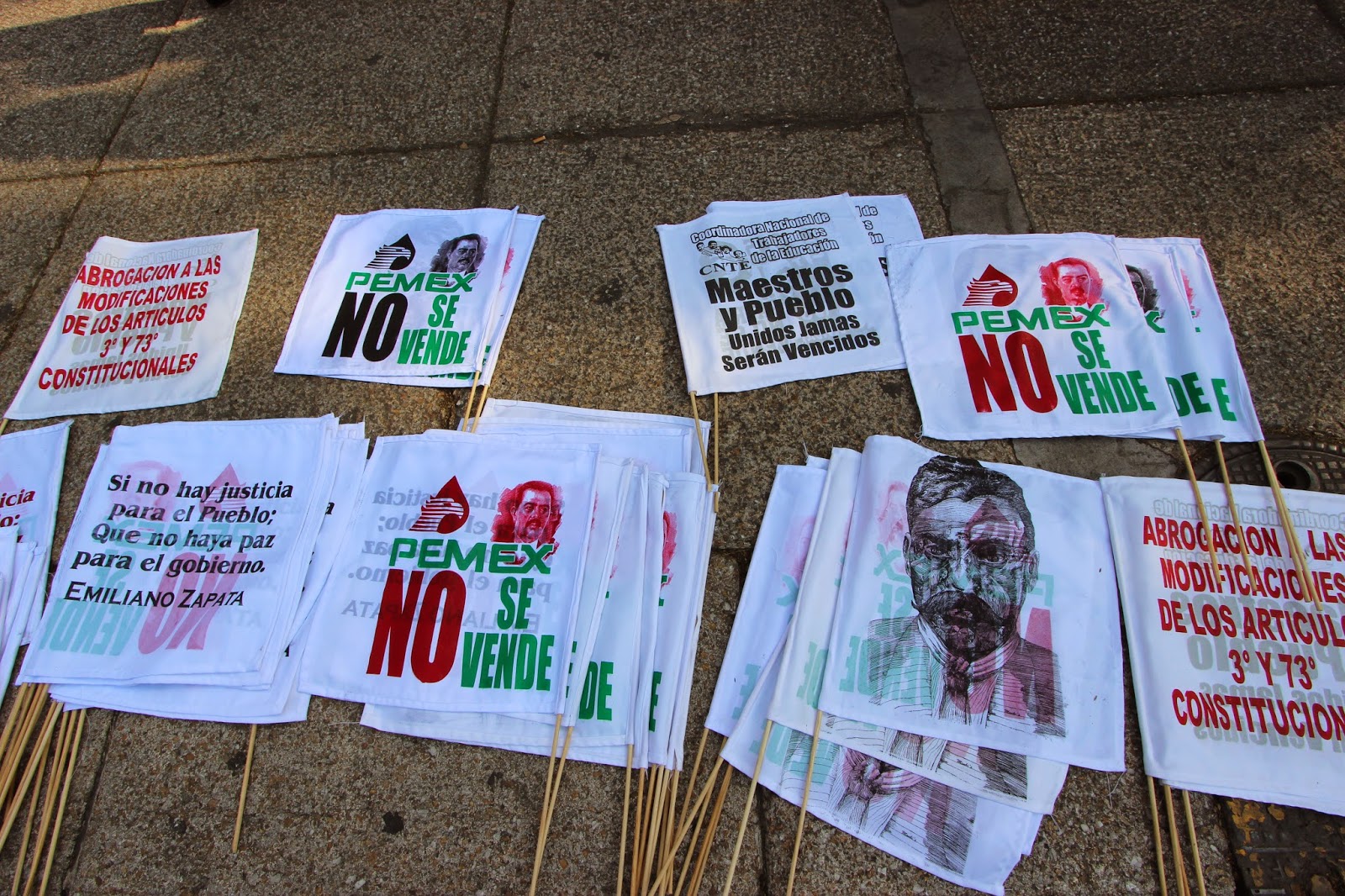
In preparation for the march, banners bearing images of Emiliano Zapata and messages like "Pemex is not for sale" and "Teachers and the public united will never be defeated" line the sidewalks.

Members of the National Coordinating Committee for the Plan de Ayala Movement march. Their International Campaign for Liberty and Justice includes demands for fair pay for workers, respect for the natural resources of small towns, and the release of political prisoners. They have joined with other small-scale farming organizations to demand that corn and beans be left out of NAFTA's agricultural chapter. 


Representatives of the Authentic Labor Front carry a sign that reads “20 years of an economic and social nightmare… 20 years of exploitation, theft, and plunder… enough is enough! No more NAFTA—no to the TPP! No to the Energy Reform, no to structural reforms!


The international delegation from the Multisector Tri-national Forum, made up of citizens from Mexico, the U.S., Canada, and  Quebec, marches through downtown Mexico City.  Representatives were present from labor unions, women's organizations, and small-scale farming, environmental and human rights groups.  

The march culminates with the gathering of thousands of protesters in Mexico City's Constitution Square.


More info about the impact of NAFTA in Mexico:
  • NAFTA at 20: Lori Wallach on US Job Losses,Record Income Inequality, Mass Displacement in Mexico by Amy Goodman, Democracy Now!
  • Numerous NAFTA Promises Not Met by the AP

More info about NAFTA’s impact in Canada, Mexico, and the United States 
  • The Workers' Scorecard on NAFTA by David Bacon, Truthout 

Take action against the TPP:
  • Take action on February 19th for the Obama/Harper/Peña Nieto Summit, in Toluca, Mexico. Organize an action in YOUR community. Contact a20.tlcan@gmail.com for more information.

Tuesday, February 11, 2014

Tri-National Multisectoral Forum 20 years of NAFTA: Enough Free Trade! No to the TPP!: Joint Declaration


Tri-National Multisectoral Forum
20 years of NAFTA: Enough Free Trade! No to the TPP!
México D.F., January 28-31, 2014

JOINT DECLARATION

On the 20th Anniversary of the signing of NAFTA, labor unions, farmers, women, environmentalists, and human rights organizations from Mexico, the United States, Canada and Quebec came together in a Tri-national Forum in Mexico City. We have assessed the impact on human, environmental, labor, social, and cultural rights. We conclude that the benefits of NAFTA were exaggerated to sell the agreement to the public. The promises made were not fulfilled, on the contrary, we have seen a rise in inequality, impoverishment of the vast majority of the population, loss of employment, job insecurity, environmental degradation, deterioration of social cohesion and increased violence.

It is clear that the economic and labor policies imposed by trade agreements lead to increasingly widespread exploitation and commercialization of public goods and ecosystems, as well as to a deepening commodification of women´s bodies. This happens by way of the privatization of public services, the weakening of social security systems and its disproportionately negative impact on women who assume the responsibilities of the care economy, and through the closure of thousands of factories, eliminating quality jobs excluding thousands of people, in particular young people, from the right to collective bargaining. It also happens through increased control by transnational corporations over sectors such as agriculture, food, energy, extractives and fishing. Community resistance to these attacks has led to the repression of democratic unions and social movements, the violation of indigenous rights, the criminalization of protest, and militarization.

NAFTA has altered the balance of power in favor of transnational corporations through
Chapter 11 investment protection. This includes investor-to-state dispute settlement, which gives corporations the ability to challenge democratic laws in special courts with extraterritorial jurisdiction. This leaves communities helpless and environmental conservation vulnerable. Increased corporate control has failed to generate shared prosperity for the community, but has enriched transnational enterprises. Particularly in Mexico (and Central America under CAFTA), it has increased the informal economy, resulting in more poverty and forcing millions of people to seek work in the north, where they encounter discrimination.

Currently, the failed model of NAFTA is being replicated in new agreements, specifically the Trans-Pacific Strategic Partnership (also known as TPP), in order to further expand the power of transnational corporations and impose greater restrictions on government regulations. These treaties are being negotiated in secret, behind citizens’ backs.

The organizations gathered at this forum condemn the NAFTA trade model and demand its renegotiation with greater transparency and equity among our communities. We also demand:

  • That all trade negotiations be opened to civil society participation, which implies prior publication of the texts, and the construction of mechanisms for information sharing, social participation and deliberation, while avoiding the imposition of fast track.

  • The removal of investor-state dispute settlement mechanism to strengthen governments’ ability to protect economic, social, cultural, environmental and labor rights, particularly for migrants.

  • That effective mechanisms to protect human, labor, and environmental rights are included in the texts of trade agreements, with sanctions equivalent to those for violation of commercial provisions.

We demand the supremacy of human rights over corporate privileges. We need to develop new models of cooperation and international exchange based on justice, solidarity and the highest ecological standards. Therefore, we reject the current trade model reflected in the attempt to impose the TPP.

We are committed to strengthening our joint movements at the sectoral and national levels, to intensify the fight in North America against this trade model, and to promote alternative models of integration.

We call on organizations and the general public to mobilize against the Three Amigos summit in Toluca on February 19, 2014, to express opposition to the TPP and other initiatives that deepen the prevailing model of free trade.

Approved on January 31, 2014 in Mexico City, DF, by the participants in this forum and delegates from the following organizations:

INTERNATIONAL ORGANIZATIONS AND NETWORKS
IndustriALL
Latinamerican Network on Debt, Development and Human Rights -Latindadd- (Peru)
Tri-National Solidarity Allianceof Unions (TSA)
UNI Global Union

CANADA
Networks
Common Frontiers Canada
Trade Justice Network (TJN)

National and Local Organizations
Canadian Labour Congress (CLC)
Council of Canadians
Maquila Solidarity Network -MSN-
National Union of Public and General Employees (NUPGE)
UNIFOR
United Steelworkers (USW Canada)
USW-Canada Humanity Fund

QUEBEC
Networks
Quebec Coalition on the Social and Environmental Impacts of Transnational Corporations in Latin America (QUISETAL)
Quebec Network on Continental Integration (RQIC)

National and Local Organizations
ATTAC-Quebec
Central of Democratic Unions (CSD)
Committee for Human Rights in Latin America (CDHAL)
Confederation of National Unions (CSN)
Conseil central du Montréal métropolitain (CCMM-CSN)
Friends of the Earth Quebec / Quebec Network of Environmental Groups (RQGE)
Quebec Federation of Workers (FTQ)
Quebec Women's Federation (FFQ) / World March of Women
Steelworkers-Quebec (USW-Qc)

UNITED STATES
Networks
Citizens Trade Campaign (CTC)
Grassroots Global Justice Alliance (GGJ)

National and Local Organizations
Academics from the University of California in Los Angeles
Academics from the University of Santa Barbara in Los Angeles
AFL-CIO
Institute for Agriculture and Trade Policy (IATP)
Institute for Policy Studies (IPS), Global Economy Project
National Farmers Union (NFU)
Public Citizen
United Electrical, Radio and Machine Workers of America (UE)
Witness for Peace

MEXICO
Networks
Alianza Mexicana por la Autodeterminación de los Pueblos (AMAP)
Alianza Nacional de Cooperativas (ALCONA)
Campaña trabajo Digno Derecho de las Mujeres
Coalición de organizaciones mexicanas por el derecho al agua (COMDA)
Mexican Action Network on Free Trade (RMALC)
Red de acción sobre Plaguicidas y Alternativas en México  A.C. (RAPAM)
Red de Género y Economía (REDGE)
Red de Productores Sociales de Vivienda
Red Maíz

National and Local Organizations
Academics from the ENAH
Academics from the UACM
Academics from the UAM-I
Academics from the UAM-X
AII Mexicana
ARIC  Campeche
Asociación Nacional de Empresas Comercializadoras de Productores del Campo (ANEC)
Asociación Sindical de Pilotos Aviadore (ASPA / UNT)
Bastión del Granero
Boca de Polen, A.C.
Brújula Metropolitana
CACEHC Trabajadoras del Hogar
CAMPO
Carnaval del Maíz
Centro de investigación laboral y asesoría sindical (CILAS)
Centro Miguel Agustín Pro Juárez (Centro PRODH)
Cleofas Cedillo, SPR de R.L.
Comisión Cuenca ríos Ameca-meca y Compañía, A.C.
Comisión de Bosques, Selvas y Producción Orgánica
Consejo de Ejidos y Comunidades Opositores a la Presa la Parota  (CECOP)
Consejo de Pueblos del Estado de Morelos
Coordinadora nacional Plan de Ayala (CNPA- Ecat.)
DECA Equipo Pueblo, A.C. – Espacio DESC
Ebano
El Café de Todos, SCRL
FIAN México – Espacio DESC
Frente Amplio Opositor a la Minera San Xavier (FAO)-REMA
Frente Auténtico del Trabajo (FAT / UNT)
Frente Democrático Campesino Chihuahua
Fronteras Comunes México
Grupo Tacuba
Productores Rurales del Bajío
RASA-Guerrero
RASA, S.C.
Red Jaliciense de Derechos Humanos
RedccamARIC
San José del Progreso, Oaxaca-REMA
Semillas de Vida
Seminario Permanente de Estudios Chichanos y de Fronteras (SPECHF)
SIDEC
Sindicato de trabajadores de la UNAM (STUNAM / UNT)
Sindicato Mexicano de Electricistas (SME)
Sindicato Nacional de Trabajadores de General Tire de México
Sindicato Nacional de Trabajadores Mineros, metalúrgicos, Siderúrgicos y Similares de la Rebública Mexicana / UNT
SITIEMS
SNTHIA
Sociedad Cooperativa El Zapote
Sociedad Cooperativa Las Vegas
Sociedad Organizada en Lucha (SOL)
SPR H. Ameyolt
STIMAHCS
STRACC
Totikes ANEC
Unión nacional de Organizaciones regionales campesinas autónomas (UNORCA)
Unión nacional de Trabajadores y Profesionistas petroleros (UNTyPP / UNT)
Unión popular revolucionaria Emiliano Zapata (UPREZ)
Unión Popular Valle Gómez, A.C.
Vice-Presidency Equity and Gender of UNT

And many more to come…
Please send your endorsement to a20.tlcan@gmail.com