Showing posts with label North American Free Trade Agreement. Show all posts

Tuesday, April 29, 2014

The Defense of the Land: San Jose del Progreso


Attacks against land are constant, and in Mexico even more so since NAFTA (North American Free Trade Agreement) went into effect in 1994. NAFTA changed laws so drastically that it sometimes seems like the government was in a rush to hand over the territory to the highest bidder, the one that offered them the most crumbs.

Thanks to NAFTA, corporations have more freedom than ever to exploit Mexican people and Mexican natural resources. Ever since 1994, the government has passed numerous reforms and neoliberal laws that benefit multinationals (the most recent ones regarding
energy, education, financial, agriculture, and communications) and that facilitate the oppression of citizens who don’t agree with the government or who fight to defend their rights.

Fortunately, all throughout Latin America groups have organized, mostly indigenous groups, which fight to defend their land, their dignity, and life itself.


Defense of Land


When I asked Carmen what land defense means, she said it’s the defense of everything. It’s the defense of wind, sun, earth, water, minerals, flora and fauna, human rights, and all of the people who inhabit a place. It’s also the defense of values, traditions and the culture of a people. It’s the continuous struggle to protect everything that mother earth gives us. It’s the struggle to continue living in harmony with the world in a sustainable way.

Carmen is an indigenous woman, and leader of a Oaxacan organization which defends the rights of indigenous peoples and mother earth. Defending land is part of her daily life.

The work of land defenders is absolutely essential. The development model which capitalism imposes has accelerated the destruction of the world and the domination of resources by a limited group of people. This “development” prioritizes short term profits and not the well-being of people or nature.


A concrete example: San José del Progreso


Oaxacan organizations which work to defend the land recently published a report on the Civilian Observatory Mission to San José del Progreso which took place at the end of 2012.

San José del Progreso is a Zapotec indigenous municipality located in Oaxaca state, which in the last eight years has been embroiled in an alarming social conflict brought about by the presense of a Canadian mine in its territory.

During the first months of 2012, two members of the Coordination of Peoples of Ocotlan Valley, Bernardo Vázquez Sánchez and Bernardo Méndez Vázquez, who had participated in the opposition to the mining company Cuzcatlán-Fortuna Silver Mines over the previous seven years, were killed…

In the report, the organizations were able to document the negative effects of the mine in the region, as well as the numerous violations of rights suffered by its residents. These violations still enjoy impunity, as the government continues to favor the company over the local residents. The government justifies its support for the mining company with the argument that the mine will bring “development” to the region.


The extractive economic model is based on the accumulation of capital thanks to the disproportionate extraction of communal resources. It presupposes that private companies, which have the capital to pay for the plundering of minerals, acquire the right to do so anywhere in the world, all in order to promote “economic development” and not the well-being of people who live on the land where the minerals are found. Under this model, people, animals, and plants are considered dispensable exchange value.

But the residents of San José know that this “development” model will only benefit a very small group of foreign investors, while the local population suffers negative impacts that the mine has on the environment and the community.


Mining is an economic activity encouraged by governments and large transnational corporations which has systematically violated the human rights of communities where such projects are realized. For these reasons, it’s considered one of the economic activities with greatest social, cultural, economic and environmental impacts.

…The temptation to acquire minerals such as gold and silver launched the colonization, pillage and exploitation of underground riches in the Americas. This historical pattern is one of the driving forces of global capitalism. Mines and underground places in which metals such as gold, silver, titanium and copper are found. These are used to produce products and exchange values, offering enormous riches to the owners of companies who extract it.

In order to extract the desired minerals, pulverized rock is combined with toxic chemical reactions such as cyanide (used in the lixiviation process) and the “xantatos” (used in the flotation process), among others. Huge amounts of water and electricity are required for this process. Once the mine is depleted, poisons remain in the mine as well as deposits, which are a source of pollution for future generations that will live in the region in the coming decades.

We invite you to read the entire report.


And what about us?


So what does land defense have to do with us? We must think about our role in this problem: how we benefit from these dynamics, and how we can work in true solidarity.

With money, privilege and power comes an attitude of arrogance, and the erroneous idea that we deserve to have anything at the price that we determine (even though there are things which don’t belong to us and which don’t have a price!).

This phenomenon can be seen on a micro and a macro level. One only needs to visit the Oaxacan coast or the streets of Brooklyn, New York. People with money buy homes from original peoples and marginalized peoples, open new businesses thanks to their access to technology and capital, and slowly displace original inhabitants.

On a bigger scale, we can see multinational corporations which bribe politicians, who then hand over permission to exploit natural resources and destroy nature at a speed never seen before. The San José del Progreso report gives us a clear glimpse into the impacts that this has on communities.

We must reflect upon the laws in our country which allow the exploitation of others on a global level. We must take our money out of companies that make their profits at the cost of marginalizing communities and groups of peoples. We must change our consumption habits and only buy what’s truly necessary. We must stop buying products from companies that profit off the destruction of the environment and social conflicts. We must learn to be better tourists, better neighbors, and better citizens. We must invest our efforts and capital in bettering our own communities.

When we stop putting a price on the most sacred things that life offers us, such as communal resources, our values, our homes, only then will we be exercising true solidarity. 

Monday, April 7, 2014

The Impact of the TPP, Part One / El Impacto del TPP, Primera Parte


Español abajo

Josh Wise, Minnesota Fair Trade Coalition

For nearly five years now, government bureaucrats and lobbyists on both sides of the Pacific Ocean have been negotiating the Trans-Pacific Partnership (TPP) in secret. Despite claims from the United States Trade Representative (USTR), Michael Froman, that this is going to be a “high-level” agreement that will create lots of jobs, everything we've learned through leaks to the public (which essentially amount to negotiators committing treason just to tell us what our government is proposing) shows that the TPP is poised to become yet another extension of the same failed trade policy and negotiating process that gave us NAFTA, CAFTA and a whole host of other agreements that have accelerated the race to the bottom for labor, environmental and human rights standards. Only this time, it's on a much larger scale.

Free trade advocates point to David Ricardo's theory of comparative advantage as the basis for eliminating trade restrictions. The idea is that if we eliminate government protections for industries, then countries will have to focus on producing what they are most efficient at and everyone pays a lower price for goods while profits are higher because of the efficiency. The reality is that the agreements that have been negotiated so far have been far from free, or even specifically about trade. Instead, what they have amounted to is a host of deregulation, and protections for investors (otherwise known as multinational corporations), which have limited the ability of governments to act in their public interest, whether in terms of labor standards, the environment or public health. This has boosted corporate profits immensely, but has resulted in a race to the bottom for the rest of us in terms of global living standards.

Why is it this way?
Well, it's really inevitable given the way we do trade negotiations. USTR is technically a diplomat, and as such, can keep trade negotiations classified. However, if you lobby the executive branch, you can get appointed as a “cleared adviser” to the negotiations, meaning you can see and influence the proposals. The TPP has more than 600 cleared advisers, many of whom represent major corporations. International treaties, of course, override all conflicting federal and local laws. So what we're left with is a system of lawmaking in which the lobbyists write the laws behind closed doors. It's no surprise then, that the final agreements disproportionately benefit the very same multinational corporations who wrote them.

What are the results?
The North American Free Trade Agreement has been in effect for 20 years as of 2014, and therefore provides the most data to analyze. Since NAFTA was enacted, the US has lost more than 1 million jobs to low-wage labor. And it’s not just low-skilled work that’s going abroad. The auto industry, medical device and chemical manufacturing and even research and development jobs are crossing the border to maquiladoras, where the average manufacturing wage is $2.50 an hour, and labor and environmental regulations are either non-existent or not enforced. Many “low-skilled” jobs, such as those in the textile industry, have long since left, as subsequent World Trade Organization and bi-lateral agreements have sent that work where the wages are even lower, such as Central America and Southeast Asia. The TPP includes Vietnam, where independent unions are illegal, and $2.50 is the average daily wage. The job loss, however, hasn’t just affected the US. Subsidized grain exports have displaced more than 2 million Mexican farm workers (fueling immigration and the drug trade) and millions of acres of land have been expropriated for mining and extractive industries.

Part Two, to be published tomorrow, will delve more into the impact of the TPP and talk about what we as citizens can do to stop it.

El Impacto del TPP


Josh Wise, Coalición por el Comercio Justo de Minnesota

Las negociaciones secretas del Acuerdo Estrategico Trans-Pacifico de la Asociacion Economica o, Trans-Pacific Partnership (TPP) han seguido efectuándose por más de cuatro años. Según las afirmaciones dadas por el Representante Comercial de Estados Unidos (USTR), Michael Froman, el TPP sería un acuerdo “de alto nivel” dando pie a la creación de nuevos trabajos y por ende oportunidades laborales. Sin embargo, toda la información que hemos recibido mediante información que se ha filtrado al público (significando un acto de traición por parte de algunos participantes con el propósito de informarnos lo que propone nuestro propio gobierno) indica que el TPP está a punto de convertirse en otra extensión más del mismo proceso fallido de negociaciones de la política del comercio; los cuales han resultado en muchos otros acuerdos que han acelerado la “carrera hacia el abismo” en cuanto de las normas laborales, ambientales y de derechos humanos. Pero esta vez, en una escala mayor.

Los defensores del comercio libre utilizan la teoría de ventaja comparativa del economista David Ricardo como base teórica para la eliminación de las restricciones del comercio. La idea es que, si eliminamos la protección del estado para ciertas industrias, los países tendrían que enfocarse en la producción de artículos que resulten más eficaces, por consiguiente, todo el mundo pagaría precios más bajos para productos y las ganancias resultarían más grandes por la eficiencia. Sin embargo, la realidad es que los acuerdos actuales se alejan del ideal de “libertad comercial”, perdiendo los hilos conductores y yendo más allá del manejo del comercio. Al contrario, se ha introducido una gran cantidad de desregulación y protecciones para los inversionistas (la mayoría de éstos son corporaciones multinacionales), las cuales han limitado la capacidad de los gobiernos para actuar en favor de los intereses públicos en temas como normas laborales, medioambientales y de salud pública. Es cierto que han resultado en grandes ganancias corporativas, pero a la vez se ha venido generando ésta carrera hacia el abismo para los demás, sobretodo teniendo un impacto en el nivel de vida global.

Por qué es así?
En realidad, estos resultados son inevitables considerando como hacemos las negociaciones sobre el comercio. Según la definición oficial de su cargo, el USTR Froman es un diplomático, y, por esta razón puede mantener en secreto el contenido de las negociaciones sobre el comercio. Sin embargo, si alguien pide a la sección ejecutiva del gobierno, puede conseguir el título de “consejero autorizado” para las negociaciones, lo que significa que se puede ver y ejercer influencia sobre las propuestas. El TPP tiene más de 600 de estos “consejeros autorizados” y muchos de ellos representan corporaciones grandes. Además, los tratados internacionales se anteponen a todas las leyes nacionales y locales – dejándonos con un sistema de creación de leyes en el cual los grupos de presión (lobbyists) escriben las leyes detrás de puertas, por tanto, no deberían sorprender. Entonces, los acuerdos finales benefician desproporcionalmente a las mismas corporaciones multinacionales que los escriben.

Cuáles son los resultados?
El Tratado de Libre Comercio de América del Norte (TLCAN) cumplió 20 años de vigencia este año, y por ser el acuerdo con mayor longevidad, tiene la mayor cantidad de datos para analizar. Desde que se estableció el TLCAN, los EEUU han perdido más de 1 millón de puestos de trabajo a sitios extranjeros de salario bajo. Y el trabajo no especializado no es el único que va para el exterior. Trabajo de la industria automóvil, de fabricación medica y química, y hasta investigación y desarrollo sigue cruzando la frontera a las maquiladoras, donde el salario promedio es $2,50 por una hora, y las normas laborales y ambientales o no existen o no se aplican. Mucho más trabajo no especializado, como el de la industria textil, desapareció hace mucho tiempo, porque los acuerdos bilaterales y los de la Organización Mundial del Comercio han controlado éste trabajo hasta donde el salario es aún más bajo, en regiones como Centroamérica y el Sudeste de Asia. El TPP incluye a Vietnam, donde los sindicatos independientes son ilegales y, $2,50 es el salario promedio diario. Entonces, la pérdida del trabajo no es solamente un tema de EEUU; las exportaciones subvencionadas de granos han causado el desplazamiento a más de 2 millones de campesinos y trabajadores mexicanos (contribuyendo a la inmigración y el tráfico de drogas) y millones de acres de tierra han sido expropiados para usos y explotación minera y de industrias extractivas.

La segunda parte de este post se publicará mañana, éste explorará más a fondo el impacto del TPP y discutirá que podremos hacer nosotros como ciudadanos para detenerlo.

Thursday, April 3, 2014

Starting to unpack the TPP, NAFTA and food sovereignty / Empezando a entender el TPP, el TLCAN y la soberanía alimentaria

Español abajo

By Allison Mountjoy, Community Alliance for Global Justice's Food Justice Project

I recently traveled to New Orleans for the first time and where did I find myself on the first day but the New Orleans food co-op. For my sister, who was traveling with me, it was not surprising when I spent thirty minutes looking through produce and taking pictures of their mission goals. Later we met up with a friend who works in New Orleans at a food hub. Naturally, the three of us spent a good chunk of time discussing what makes a good co-op, the merits of local food, and the designs for working city infrastructure.

Just two days later, and back in Seattle, I was sitting in a Food Justice Project meeting struggling to hold my own in a conversation about the Trans-Pacific Partnership (TPP) and was struck by experience in New Orleans. Picture three middle-class, over-educated, white women sitting on a porch drinking Guinness, eating guacamole, and criticizing the only food co-op in one of America’s biggest food deserts for not having the buying and distribution power of a Whole Foods. There is something very challenging in that picture and it only got more challenging when I started researching the TPP back in Seattle.

Many of us (myself included) have strong beliefs about sustainable and equitable food systems but so much of what we all, as consumers, are confronted with as information is murky at best. I’m not exactly new to the conversation about the TPP or Free Trade Agreements in general but I felt on such rocky ground trying to talk about it that night in Seattle. My knowledge of the TPP leaned heavily on comparisons to the North American Free Trade Agreement (NAFTA). I have been on industrial and subsistence farms in Mexico and seen the results of NAFTA first hand in fields and grocery stores. So, it’s understandable that my first instinct on the TPP is to be wary; it is being called ‘NAFTA on steroids’ after all. But what do I really know about the TPP?

  • Who has the most to gain? Importers, exporters, distributors, or farmers? Why is most of the public information on this coming from WikiLeaks?
  • How will our food safety standards be upheld as the seafood import market is expected to increase?
  • If seafood becomes cheaper to import from the South Pacific how will this affect our more local fishermen, shellfish farmers, and economies?
  • How will this impact the livelihoods of South Pacific fishers, farmers and their families?
  • Trade agreements are supposed to increase economic welfare for both food producers and consumers, so what should our recent experience with NAFTA teach us about this?
The three of us in New Orleans had the luxury of choosing, advocating for, and working on a sustainable food system. But Free Trade Agreements like NAFTA made it possible for us to sit on that porch and enjoy beer from Ireland and avocados from Mexico. So I invite anyone reading this to ask the hard questions, the ones that sometimes make us uncomfortable or maybe challenge our lifestyles.

Somewhere to start:

The New York Times, “The Broken Promise of NAFTA” http://www.nytimes.com/2004/01/06/opinion/the-broken-promise-of-nafta.html

The Washington Post, “Everything you Need to Know about the Trans-Pacific Partnership” http://www.washingtonpost.com/blogs/wonkblog/wp/2013/12/11/everything-you-need-to-know-about-the-trans-pacific-partnership/

Seattle Global Justice, “Reasons Why Food Justice Activists Should Care about the TPP” http://www.seattleglobaljustice.org/2012/11/10-reasons-why-food-justice-activists-should-care-about-the-tpp/#_ftn9

Congresswoman Rosa DeLauro. “Food Safety Critical Issues in Upcoming Trade Talks”http://delauro.house.gov/index.php?option=com_content&view=article&id=406:-delauro-food-safety-critical-issue-in-upcoming-trade-talks&catid=7:2011-press-releases&Itemid=23

Por Allison Mountjoy, Proyecto por la Justicia Alimentaria de la Alianza Comunitaria por la Justicia Mundial

Hace poco viajé a Nueva Orleans por la primera vez y a dónde mas fui que al lugar de la cooperativa alimentaria de Nueva Orleans. Para mi hermana, que me acompañaba, no era para nada sorprendente que gastara 30 minutos mirando verduras y sacando fotos de la misión y las metas de la cooperativa. Luego nos encontramos con una persona amiga nuestra que trabaja en Nueva Orleans en un mercado alimentario. Naturalmente, pasamos un buen rato conversando acerca de qué hace a una buena cooperativa, los beneficios de los alimentos locales y los planes para una infraestructura urbana funcional.

Dos días después, de regreso en Seattle, estaba sentada en una reunión del Proyecto por la Justicia Alimentaria tratando de defender mis argumentos en una conversación sobre el Tratado Trans-Pacificio (TPP por sus siglas en inglés) y volvia recordar la experiencia que tuve en Nueva Orleans. Imagínese tres mujeres blancas, de clase media, y de un alto nivel de educación sentadas en un balcón tomando Guinness, comiendo guacamole y criticando la única cooperativa alimentaria en uno de los desiertos alimentarios mas grandes de Estados Unidos por no tener el poder adquisitivo ni de distribución de un Whole Foods. Hay algo desafiante en esa imagen, y sólo se volvió más compleja cuando empecé a investigar el TPP en Seattle.

Muchxs de nosotrxs (incluida yo misma) tenemos opiniones fuertes sobre sistemas alimentarios sostenibles y equitativos pero mucha de la información disponible para nosotrxs lxs consumidores es bastante confusa. Yo no soy nueva en la conversación sobre el TPP o los Tratados de Libre Comercio por lo general, pero no sabía cómo articular esos temas esa noche en Seattle. Mi conocimiento del TPP dependía mucho de comparaciones al Tratado de Libre Comercio de América del Norte (TLCAN, o NAFTA por sus siglas en inglés). He estado en granjas industriales y granjas campesinas en México y he visto de primera mano los resultados del TCLAN en el campo y en los supermercados. Entonces, con razón mi primer instinto frente el TPP es ser suspicaz; su apodo es “TLCAN en esteroides.” Pero, ¿qué sé yo realmente del TPP?
  • ¿Quién gana más de este acuerdo? Los importadores, los exportadores, o lxs campesinxs?
  • ¿Por qué la mayoría de la información pública sobre este asunto viene de WikiLeaks?
  • ¿Cómo se mantendrán nuestros normas de seguridad alimentaria frente a la ampliación esperada del mercado de importaciones de mariscos?
  • ¿Si vuelve más económico importar mariscos del Sur Pacífico, como afectará esto a nuestros pescadores, cultivadores de mariscos y economías locales?
  • ¿Como afectará a lxs pescadores en el Sur Pacífico, lxs campesinxs y sus familias?  
  • ¿Se supone que los tratados de comercio aumentan el bienestar económico para ambos lxs productores y lxs consumidores, entonces qué nos debería enseñar nuestra experiencia con el TLCAN? 

Nosotrxs tres en Nueva Orleans tuvimos el privilegio de escoger, incidir por y trabajar en sistemas alimentarios sostenibles. Pero los TLCs como el TLCAN hicieron posible que nosotrxs nos sentáramos en el balcón disfrutando cerveza de Irlanda y aguacates de México. Pues lxs invitamos hacerse las preguntas difíciles, esas que a veces nos incomodan o que tal vez desafían nuestro estilo de vida.

Para comenzar:

The New York Times, “The Broken Promise of NAFTA” http://www.nytimes.com/2004/01/06/opinion/the-broken-promise-of-nafta.html

The Washington Post, “Everything you Need to Know about the Trans-Pacific Partnership” http://www.washingtonpost.com/blogs/wonkblog/wp/2013/12/11/everything-you-need-to-know-about-the-trans-pacific-partnership/

Seattle Global Justice, “Reasons Why Food Justice Activists Should Care about the TPP” http://www.seattleglobaljustice.org/2012/11/10-reasons-why-food-justice-activists-should-care-about-the-tpp/#_ftn9

Congresswoman Rosa DeLauro. “Food Safety Critical Issues in Upcoming Trade Talks”http://delauro.house.gov/index.php?option=com_content&view=article&id=406:-delauro-food-safety-critical-issue-in-upcoming-trade-talks&catid=7:2011-press-releases&Itemid=23

Thursday, February 13, 2014

NAFTA at 20: the struggle continues!


It all started 20 years ago, on January 1st of 1994, when the North American Free Trade Agreement (NAFTA) went into effect. Despite the promises of wealth, progress, and job creation, multinational corporations emerged as the sole beneficiaries of NAFTA and left many others in desperate situations. The effects of NAFTA have been devastating for the citizens of Mexico, Canada, and the United States.

In Mexico, NAFTA opened the door to transnational corporations allowing them to operate freely and at a lower cost. To date, these corporations continue to profit from the benefits that NAFTA has allotted them. Companies reap immense profits by paying almost no taxes or tariffs and by being immune to quotas and other safeguards for national industries. They pay low wages to workers, who are losing their ability to organize unions, and adhere to few if any substantial environmental regulations. All of this and more while even the most conservative estimates indicate that over 50% of the Mexican population lives in poverty.

Since the implementation of NAFTA, the Mexican government has steadily implemented reforms in various sectors to continue bolstering the vastly lopsided power dynamic between international corporations and the majority of the population.

The current PRI government of Enrique Pena Nieto is determined to eliminate the few protections that remain in place for the average Mexican by implementing a series of structural reforms (energy, education, financial, agrarian, and tax reform) that continue to benefit powerful corporations.

In addition, Mexico is one of the 12 countries currently negotiating a new free trade agreement: the Trans-Pacific Partnership (TPP). The TPP could be the most dangerous FTA to date. The meetings related to the TPP have been secret to the general public, but open to transnational corporations, who are working hard to advocate for conditions that increase their profits and protect their interests.

But people across North America are organizing and demanding change. January 31st was the Day of Action Against Free Trade, TPP, and Corporate Globalization. More than 50 actions took place on this day across North America.

In Mexico, the Multisector Tri-National Forum “20 years of NAFTA is Enough: No More Free Trade! No TPP! ” took place during the last week of January. Citizens from Mexico, Canada, and the United States came together to share their experiences concerning the twenty-year-old free trade agreement. They organized forums, discussions, plenaries, and presentations about the impacts of NAFTA in their communities.


Leovigildo Vásquez Sánchez, a member of the Coordinating Committee of the United Towns of the Ocotlán Valley (CPUVO by its Spanish initials), speaks at the forum. Vásquez is from the town of San José del Progreso, which has experienced violence and repression as a result of the community's efforts to stop Canadian mining company Fortuna Silver Mines, Inc. (owned and operated by Cuzcatlan S.A. de C.V., its local subsidiary) from extracting gold and silver from a mine close to the town.

The event culminated when participants created a joint declaration against free trade agreements and then joined approximately 100,000 people in Mexico City in a march protesting the reforms of the Pena Nieto administration. These reforms will advance the neoliberal plan that started with the passage of NAFTA, and that our governments intend to expand even more with the passage of the TPP.

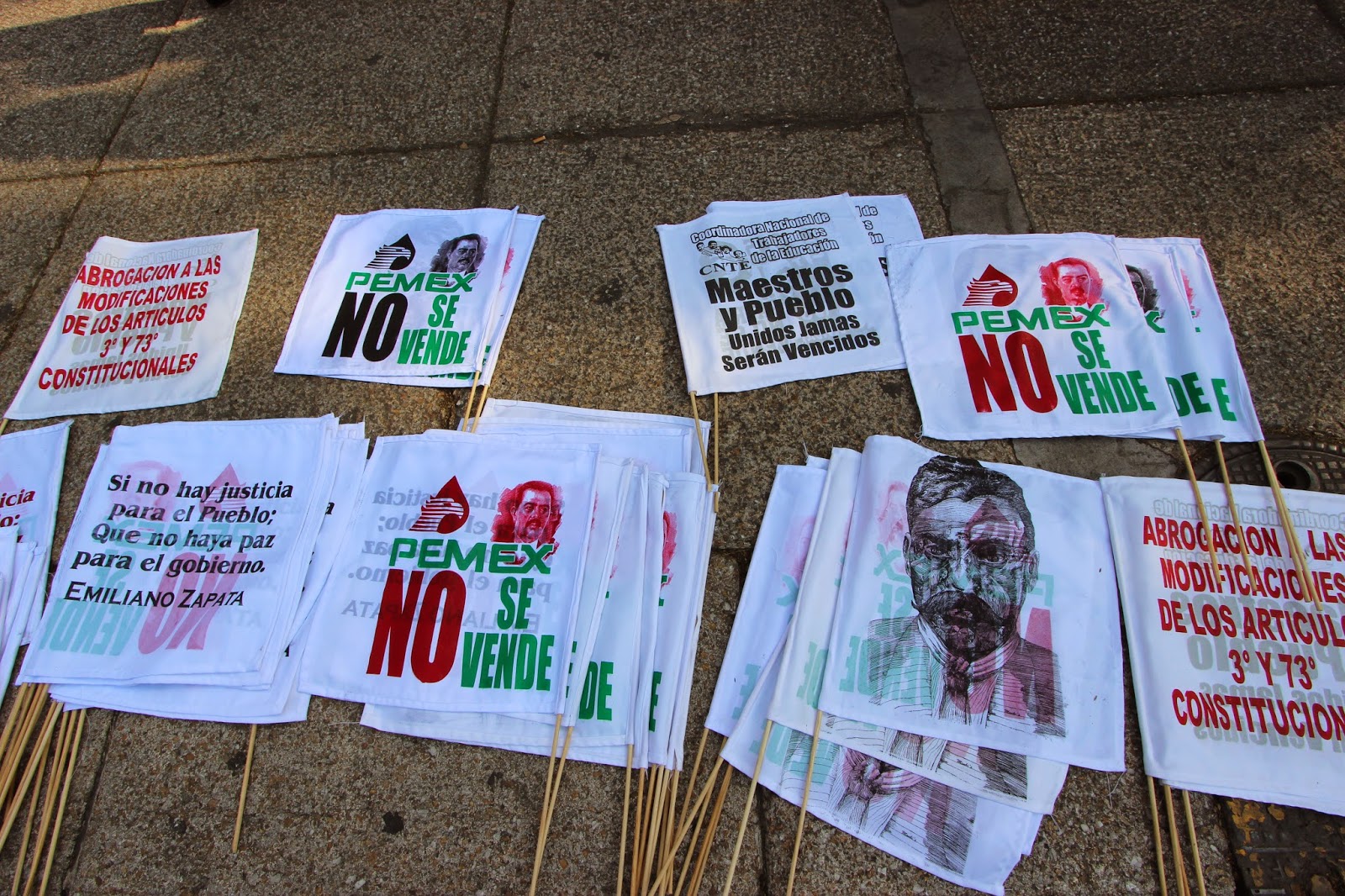
Below are some photographs from the march. Please explore the links to learn more and take action against damaging free trade agreements!


In preparation for the march, banners bearing images of Emiliano Zapata and messages like "Pemex is not for sale" and "Teachers and the public united will never be defeated" line the sidewalks.

Members of the National Coordinating Committee for the Plan de Ayala Movement march. Their International Campaign for Liberty and Justice includes demands for fair pay for workers, respect for the natural resources of small towns, and the release of political prisoners. They have joined with other small-scale farming organizations to demand that corn and beans be left out of NAFTA's agricultural chapter. 


Representatives of the Authentic Labor Front carry a sign that reads “20 years of an economic and social nightmare… 20 years of exploitation, theft, and plunder… enough is enough! No more NAFTA—no to the TPP! No to the Energy Reform, no to structural reforms!


The international delegation from the Multisector Tri-national Forum, made up of citizens from Mexico, the U.S., Canada, and  Quebec, marches through downtown Mexico City.  Representatives were present from labor unions, women's organizations, and small-scale farming, environmental and human rights groups.  

The march culminates with the gathering of thousands of protesters in Mexico City's Constitution Square.


More info about the impact of NAFTA in Mexico:
  • NAFTA at 20: Lori Wallach on US Job Losses,Record Income Inequality, Mass Displacement in Mexico by Amy Goodman, Democracy Now!
  • Numerous NAFTA Promises Not Met by the AP

More info about NAFTA’s impact in Canada, Mexico, and the United States 
  • The Workers' Scorecard on NAFTA by David Bacon, Truthout 

Take action against the TPP:
  • Take action on February 19th for the Obama/Harper/Peña Nieto Summit, in Toluca, Mexico. Organize an action in YOUR community. Contact a20.tlcan@gmail.com for more information.

Tuesday, February 11, 2014

Tri-National Multisectoral Forum 20 years of NAFTA: Enough Free Trade! No to the TPP!: Joint Declaration


Tri-National Multisectoral Forum
20 years of NAFTA: Enough Free Trade! No to the TPP!
México D.F., January 28-31, 2014

JOINT DECLARATION

On the 20th Anniversary of the signing of NAFTA, labor unions, farmers, women, environmentalists, and human rights organizations from Mexico, the United States, Canada and Quebec came together in a Tri-national Forum in Mexico City. We have assessed the impact on human, environmental, labor, social, and cultural rights. We conclude that the benefits of NAFTA were exaggerated to sell the agreement to the public. The promises made were not fulfilled, on the contrary, we have seen a rise in inequality, impoverishment of the vast majority of the population, loss of employment, job insecurity, environmental degradation, deterioration of social cohesion and increased violence.

It is clear that the economic and labor policies imposed by trade agreements lead to increasingly widespread exploitation and commercialization of public goods and ecosystems, as well as to a deepening commodification of women´s bodies. This happens by way of the privatization of public services, the weakening of social security systems and its disproportionately negative impact on women who assume the responsibilities of the care economy, and through the closure of thousands of factories, eliminating quality jobs excluding thousands of people, in particular young people, from the right to collective bargaining. It also happens through increased control by transnational corporations over sectors such as agriculture, food, energy, extractives and fishing. Community resistance to these attacks has led to the repression of democratic unions and social movements, the violation of indigenous rights, the criminalization of protest, and militarization.

NAFTA has altered the balance of power in favor of transnational corporations through
Chapter 11 investment protection. This includes investor-to-state dispute settlement, which gives corporations the ability to challenge democratic laws in special courts with extraterritorial jurisdiction. This leaves communities helpless and environmental conservation vulnerable. Increased corporate control has failed to generate shared prosperity for the community, but has enriched transnational enterprises. Particularly in Mexico (and Central America under CAFTA), it has increased the informal economy, resulting in more poverty and forcing millions of people to seek work in the north, where they encounter discrimination.

Currently, the failed model of NAFTA is being replicated in new agreements, specifically the Trans-Pacific Strategic Partnership (also known as TPP), in order to further expand the power of transnational corporations and impose greater restrictions on government regulations. These treaties are being negotiated in secret, behind citizens’ backs.

The organizations gathered at this forum condemn the NAFTA trade model and demand its renegotiation with greater transparency and equity among our communities. We also demand:

  • That all trade negotiations be opened to civil society participation, which implies prior publication of the texts, and the construction of mechanisms for information sharing, social participation and deliberation, while avoiding the imposition of fast track.

  • The removal of investor-state dispute settlement mechanism to strengthen governments’ ability to protect economic, social, cultural, environmental and labor rights, particularly for migrants.

  • That effective mechanisms to protect human, labor, and environmental rights are included in the texts of trade agreements, with sanctions equivalent to those for violation of commercial provisions.

We demand the supremacy of human rights over corporate privileges. We need to develop new models of cooperation and international exchange based on justice, solidarity and the highest ecological standards. Therefore, we reject the current trade model reflected in the attempt to impose the TPP.

We are committed to strengthening our joint movements at the sectoral and national levels, to intensify the fight in North America against this trade model, and to promote alternative models of integration.

We call on organizations and the general public to mobilize against the Three Amigos summit in Toluca on February 19, 2014, to express opposition to the TPP and other initiatives that deepen the prevailing model of free trade.

Approved on January 31, 2014 in Mexico City, DF, by the participants in this forum and delegates from the following organizations:

INTERNATIONAL ORGANIZATIONS AND NETWORKS
IndustriALL
Latinamerican Network on Debt, Development and Human Rights -Latindadd- (Peru)
Tri-National Solidarity Allianceof Unions (TSA)
UNI Global Union

CANADA
Networks
Common Frontiers Canada
Trade Justice Network (TJN)

National and Local Organizations
Canadian Labour Congress (CLC)
Council of Canadians
Maquila Solidarity Network -MSN-
National Union of Public and General Employees (NUPGE)
UNIFOR
United Steelworkers (USW Canada)
USW-Canada Humanity Fund

QUEBEC
Networks
Quebec Coalition on the Social and Environmental Impacts of Transnational Corporations in Latin America (QUISETAL)
Quebec Network on Continental Integration (RQIC)

National and Local Organizations
ATTAC-Quebec
Central of Democratic Unions (CSD)
Committee for Human Rights in Latin America (CDHAL)
Confederation of National Unions (CSN)
Conseil central du Montréal métropolitain (CCMM-CSN)
Friends of the Earth Quebec / Quebec Network of Environmental Groups (RQGE)
Quebec Federation of Workers (FTQ)
Quebec Women's Federation (FFQ) / World March of Women
Steelworkers-Quebec (USW-Qc)

UNITED STATES
Networks
Citizens Trade Campaign (CTC)
Grassroots Global Justice Alliance (GGJ)

National and Local Organizations
Academics from the University of California in Los Angeles
Academics from the University of Santa Barbara in Los Angeles
AFL-CIO
Institute for Agriculture and Trade Policy (IATP)
Institute for Policy Studies (IPS), Global Economy Project
National Farmers Union (NFU)
Public Citizen
United Electrical, Radio and Machine Workers of America (UE)
Witness for Peace

MEXICO
Networks
Alianza Mexicana por la Autodeterminación de los Pueblos (AMAP)
Alianza Nacional de Cooperativas (ALCONA)
Campaña trabajo Digno Derecho de las Mujeres
Coalición de organizaciones mexicanas por el derecho al agua (COMDA)
Mexican Action Network on Free Trade (RMALC)
Red de acción sobre Plaguicidas y Alternativas en México  A.C. (RAPAM)
Red de Género y Economía (REDGE)
Red de Productores Sociales de Vivienda
Red Maíz

National and Local Organizations
Academics from the ENAH
Academics from the UACM
Academics from the UAM-I
Academics from the UAM-X
AII Mexicana
ARIC  Campeche
Asociación Nacional de Empresas Comercializadoras de Productores del Campo (ANEC)
Asociación Sindical de Pilotos Aviadore (ASPA / UNT)
Bastión del Granero
Boca de Polen, A.C.
Brújula Metropolitana
CACEHC Trabajadoras del Hogar
CAMPO
Carnaval del Maíz
Centro de investigación laboral y asesoría sindical (CILAS)
Centro Miguel Agustín Pro Juárez (Centro PRODH)
Cleofas Cedillo, SPR de R.L.
Comisión Cuenca ríos Ameca-meca y Compañía, A.C.
Comisión de Bosques, Selvas y Producción Orgánica
Consejo de Ejidos y Comunidades Opositores a la Presa la Parota  (CECOP)
Consejo de Pueblos del Estado de Morelos
Coordinadora nacional Plan de Ayala (CNPA- Ecat.)
DECA Equipo Pueblo, A.C. – Espacio DESC
Ebano
El Café de Todos, SCRL
FIAN México – Espacio DESC
Frente Amplio Opositor a la Minera San Xavier (FAO)-REMA
Frente Auténtico del Trabajo (FAT / UNT)
Frente Democrático Campesino Chihuahua
Fronteras Comunes México
Grupo Tacuba
Productores Rurales del Bajío
RASA-Guerrero
RASA, S.C.
Red Jaliciense de Derechos Humanos
RedccamARIC
San José del Progreso, Oaxaca-REMA
Semillas de Vida
Seminario Permanente de Estudios Chichanos y de Fronteras (SPECHF)
SIDEC
Sindicato de trabajadores de la UNAM (STUNAM / UNT)
Sindicato Mexicano de Electricistas (SME)
Sindicato Nacional de Trabajadores de General Tire de México
Sindicato Nacional de Trabajadores Mineros, metalúrgicos, Siderúrgicos y Similares de la Rebública Mexicana / UNT
SITIEMS
SNTHIA
Sociedad Cooperativa El Zapote
Sociedad Cooperativa Las Vegas
Sociedad Organizada en Lucha (SOL)
SPR H. Ameyolt
STIMAHCS
STRACC
Totikes ANEC
Unión nacional de Organizaciones regionales campesinas autónomas (UNORCA)
Unión nacional de Trabajadores y Profesionistas petroleros (UNTyPP / UNT)
Unión popular revolucionaria Emiliano Zapata (UPREZ)
Unión Popular Valle Gómez, A.C.
Vice-Presidency Equity and Gender of UNT

And many more to come…
Please send your endorsement to a20.tlcan@gmail.com